
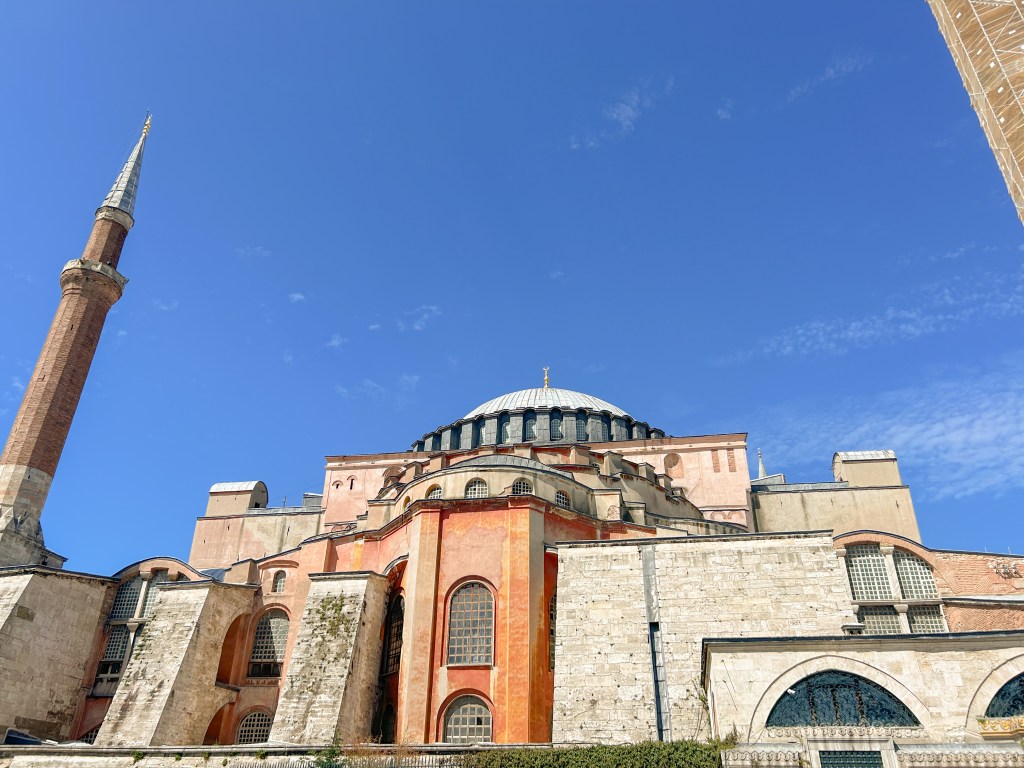
So you’re in Istanbul. If you’ve done any research at all, you will know that the top sight to see on every list is the Hagia Sophia. Perfect, add that to the list! You simply cannot skip a visit to this building when in Istanbul. That being said, what you might not know is that at the beginning of this year, entrance to the Hagia Sophia changed significantly. In this post, I’ll give you all the information you need to effectively visit this historic gem in the heart of Istanbul.
- What is the Hagia Sophia?
- Changes for Tourists in 2024
- How to Purchase Tickets for the Hagia Sophia
- Practical Details & Tips for Visiting
- Inside the Hagia Sophia
- Conclusion
What is the Hagia Sophia?
A Brief Introduction
The Hagia Sophia is, to many people, a building that needs no introduction. But for those of you that don’t know, the Hagia Sophia is a religious building constructed in 537 by the Byzantine emperor Justinian I. It was originally constructed as a Christian cathedral for the city of Constantinople (modern Istanbul) but has held many titles in the years since. Just to give you a quick grasp of the grandeur of this building, listen to this: the Hagia Sophia was the largest building in the world from its construction until 1520! If that’s not impressive, then I don’t know what is. The building has been revered admired as an artistic and engineering marvel since its construction. To this day, 3.5 million visitors flock to the Hagias Sophia every year, eager to witness its beauty with their own eyes.
Official Title of the Building
I told you that the Hagia Sophia was originally built as a church, but what is it classified as today? Is it a church? A mosque? A museum? This can be quite confusing because over the course of almost 1,500 years it’s held all of these titles. From the time of its completion in 537 until 1453, it held the title of church. Then after the Ottoman conquest, it was converted into a mosque and served that role until 1935. From 1935 until 2020, the Hagia Sophia was listed as a museum. And then in 2020, it was finally converted back into a mosque. Today it officially serves as an active mosque. So now you might be wondering, if it turned back into a mosque in 2020, how could anything have changed in 2024?
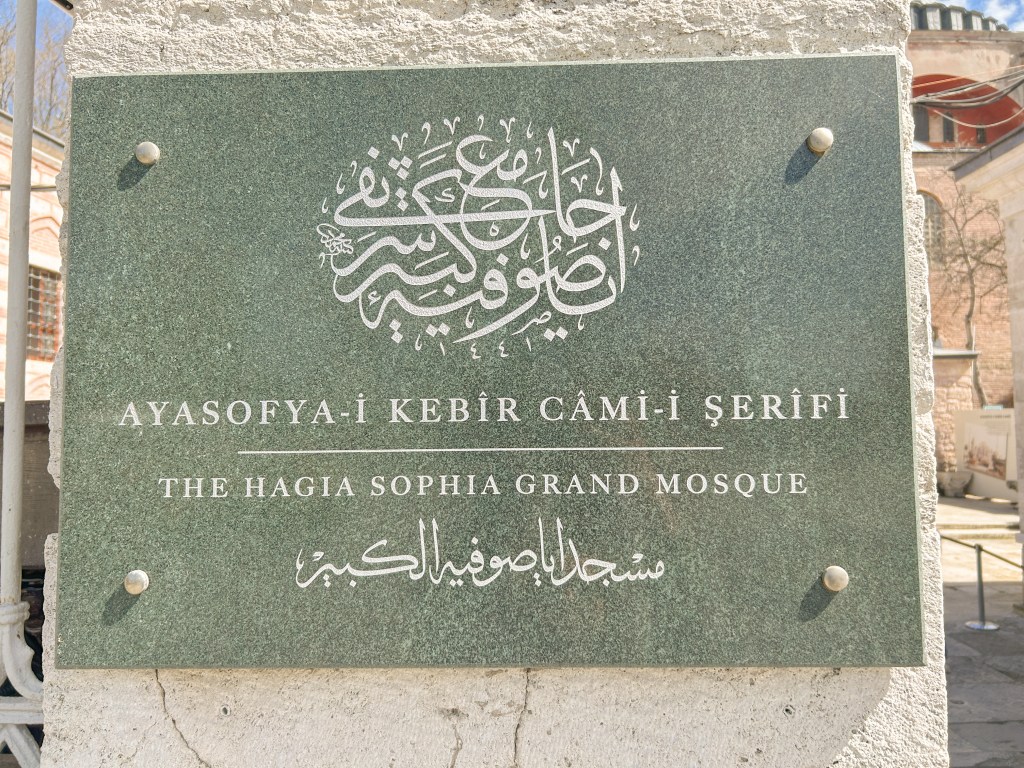
Changes for Tourists in 2024
Prior to January of 2024, tourists would visit the Hagia Sophia in the same manner as other mosques in the city. Muslims and non-muslims alike could visit the mosque for free from the ground floor, with a line or barrier separating tourists and worshippers. Essentially, everyone had pretty equal access to the main area of the building.
But starting this year, tourists are only allowed to visit via a separate entrance. This entrance leads to the upstairs ‘U’ shaped portion of the mosque known as the sanctuary floor. From here you can look down to the floor area where Turkish nationals and worshiping Muslims visit. And with this change also comes a new, and pretty hefty, entrance fee of €25 per person. Prior to this year it was free to visit the Hagia Sophia.
How to Purchase Tickets for the Hagia Sophia
Tickets can only be purchased via the official ticket booth. The price is €25 per person, with children under 8 years old being free. Don’t purchase tickets online! There is no official website and you could get scammed. There are also no museum passes that cover the Hagia Sophia.
I will also leave you with this word of wisdom: do not purchase the Hagia Sophia + Museum ticket when you’re at the ticket booth and they ask you. Frankly, I got confused thinking that the ‘museum’ was what the upstairs portion was called. Plus the ticket booth literally said “Hagia Sophia tickets only”. So I thought that was the correct ticket. I was given the price in Turkish Lira, and didn’t check the exchange rate before paying. Rookie mistake. Anyway I ended up spending $54 USD (!!!) to enter the Hagia Sophia and for a museum ticket to a completely separate building that I didn’t even use. I tried to get a refund but the worker told me that I had to wait 2-4 hours and could not enter the mosque in that time. Clearly they didn’t want to give me a refund. You’ve been warned.
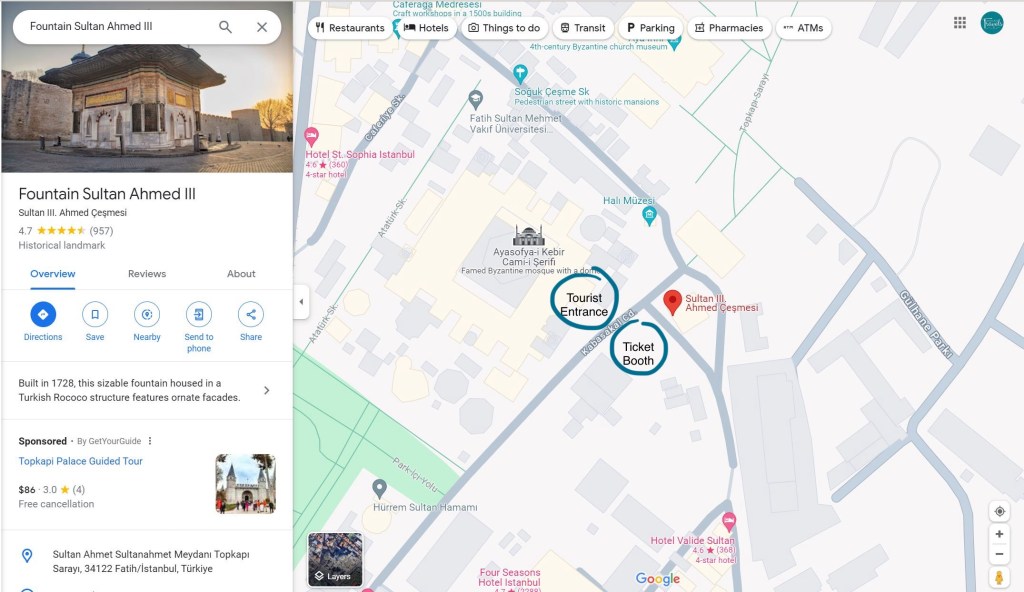
Official Ticket Booth Location
The ticket booth & tourist entrance is located near the Fountain Sultan Ahmed III. And no, this is not the fountain in the courtyard between the Hagia Sophia and the Blue Mosque, in fact it doesn’t even look like a fountain. You can view the location for the ticket booth in the google maps photo below. But you’ll likely be able to find it pretty easily by looking for the long line. The line on the right-hand side is for purchasing tickets and the line on the left-hand side is for entering the mosque. A lot of people will approach you in line trying to say they have “skip the line tickets” and are tour guides. Just firmly say ‘”no, thank you” and ignore them.
Practical Details & Tips for Visiting
Dress Code
You should dress appropriately to visit a mosque. Men need to be wearing pants and women need to wear long pants or a skirt. Don’t wear crop tops or tank tops. Women have to wear a head covering to enter. You can bring your own or purchase one for 30TL near the entrance. Just be respectful and don’t push the dress code.
Hours of Operation
The Hagia Sophia is open to tourists from 09:00 – 19:30 daily. The only day which you may experience interruptions is between 12:00 and 14:30 on Fridays due to prayer.
I suggest planning to visit early in the day, ideally when they first open at 09:00am. I would arrive earlier than 09:00 if you don’t want to wait very long in line. The later you visit, the longer the line. And in the summer it will get hot very quickly waiting in a long line. It might also be a good time to visit closer to closing time. I would anticipate there isn’t a very long line in the late afternoon / early evening.
What to Bring
Your ticket includes a free guided tour which you have to access via a QR code on your phone. The building does have wi-fi, but neither I nor my partner could get it to work. So if you don’t have cellular data, and the wi-fi doesn’t work, then no guide for you.
Make sure to plan ahead and bring a pair of headphones to listen to the audio guide. It gives some pretty interesting information so don’t miss out!
Inside the Hagia Sophia
Once you go through the tourist entrance on the side, you walk through security, and then head up a stone staircase. Be patient, there are a lot of older people who are slow going up. Once you reach the top, you will find the QR code signs for the audio guide. From here, you’re free to roam.
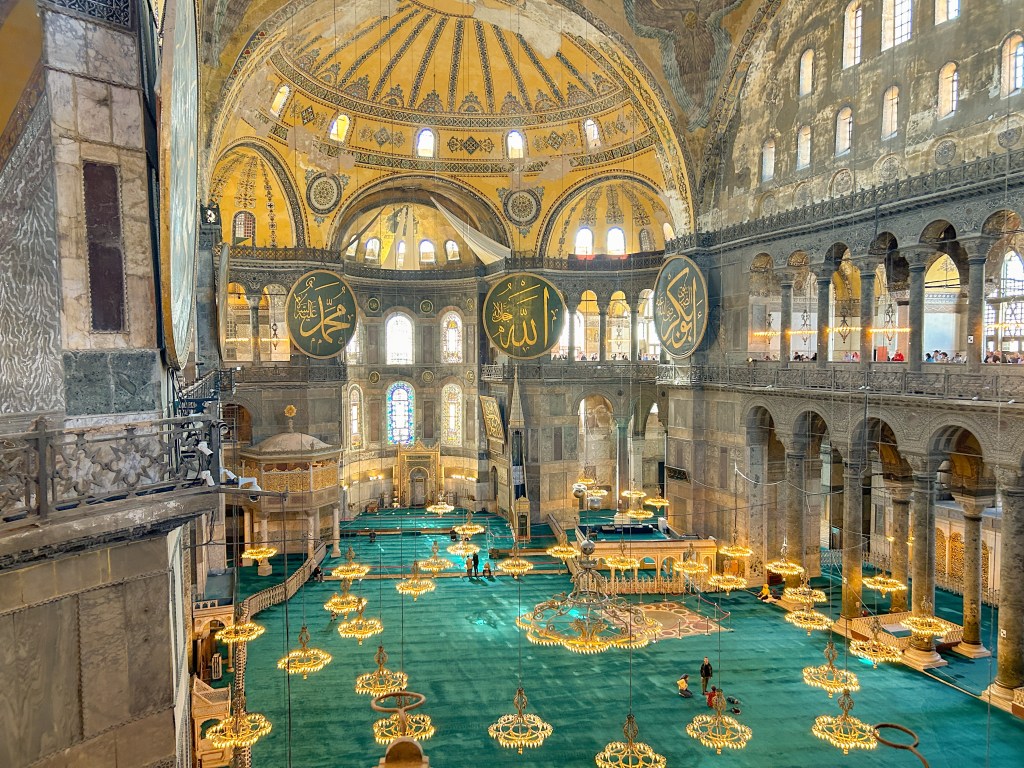
The sanctuary floor that you are on runs around the perimeter of the mosque in a ‘U’ shape. You are very high up and if you head to the railings near the edge, you’ll be able to see everything. Use your eyes and search for different elements around the church. There are elements of the modern mosque below, but hidden around you can find evidence that it used to be a church. The audio guide will also help you see all the highlights.
The only portions of the former church, such as mosaics, that are covered up are those that are in the front of the church. Because this is the direction of Mecca, and where Muslims face when praying, there are some large tarps that cover the art from below. From above, at the right angles, you can see behind the tarps. A couple of the notable things to look out for are: mosaics (such as the large angel heads and the VI. Leon Mosaic), large calligraphy plates, and the massive dome in the center.
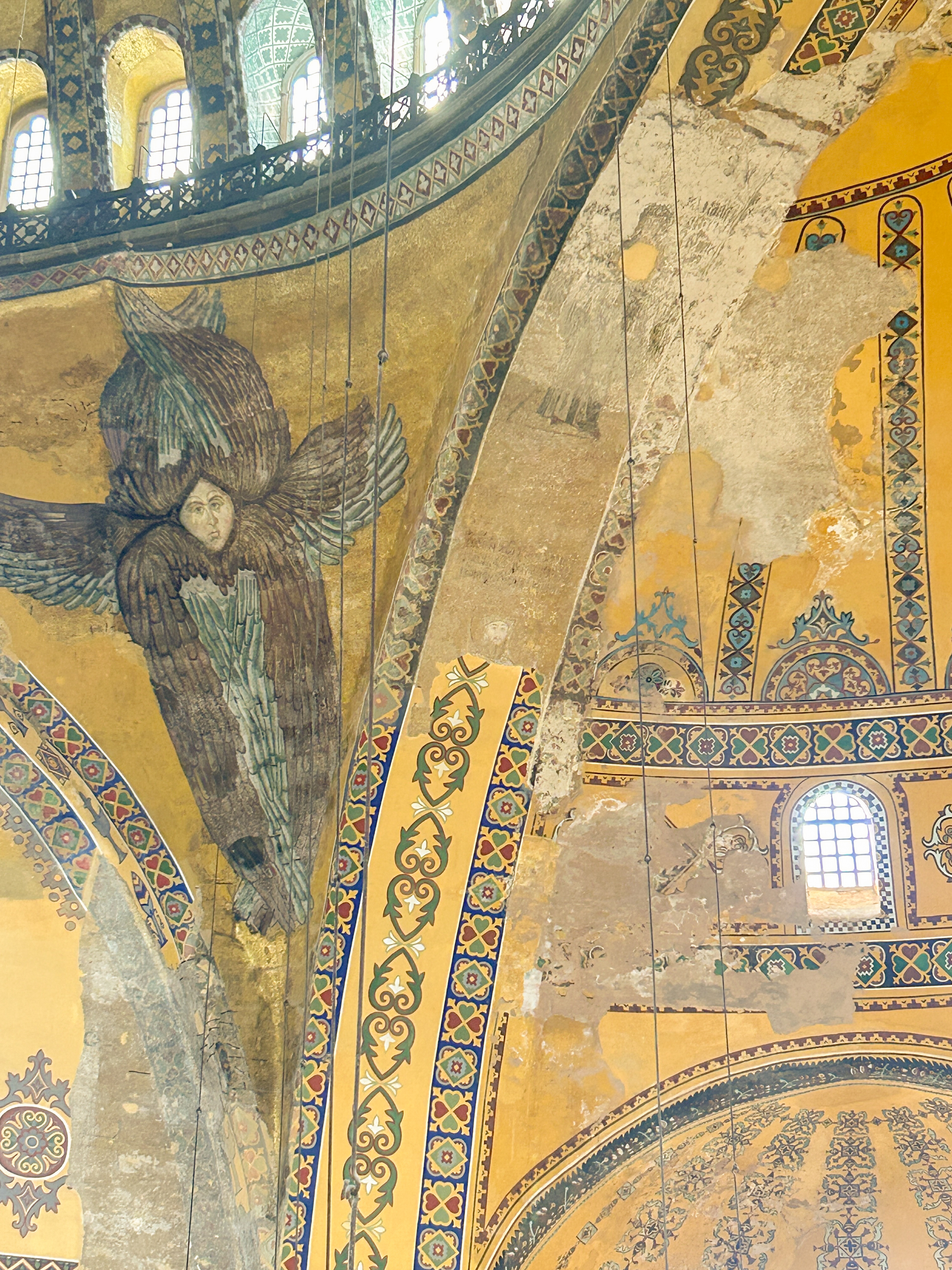
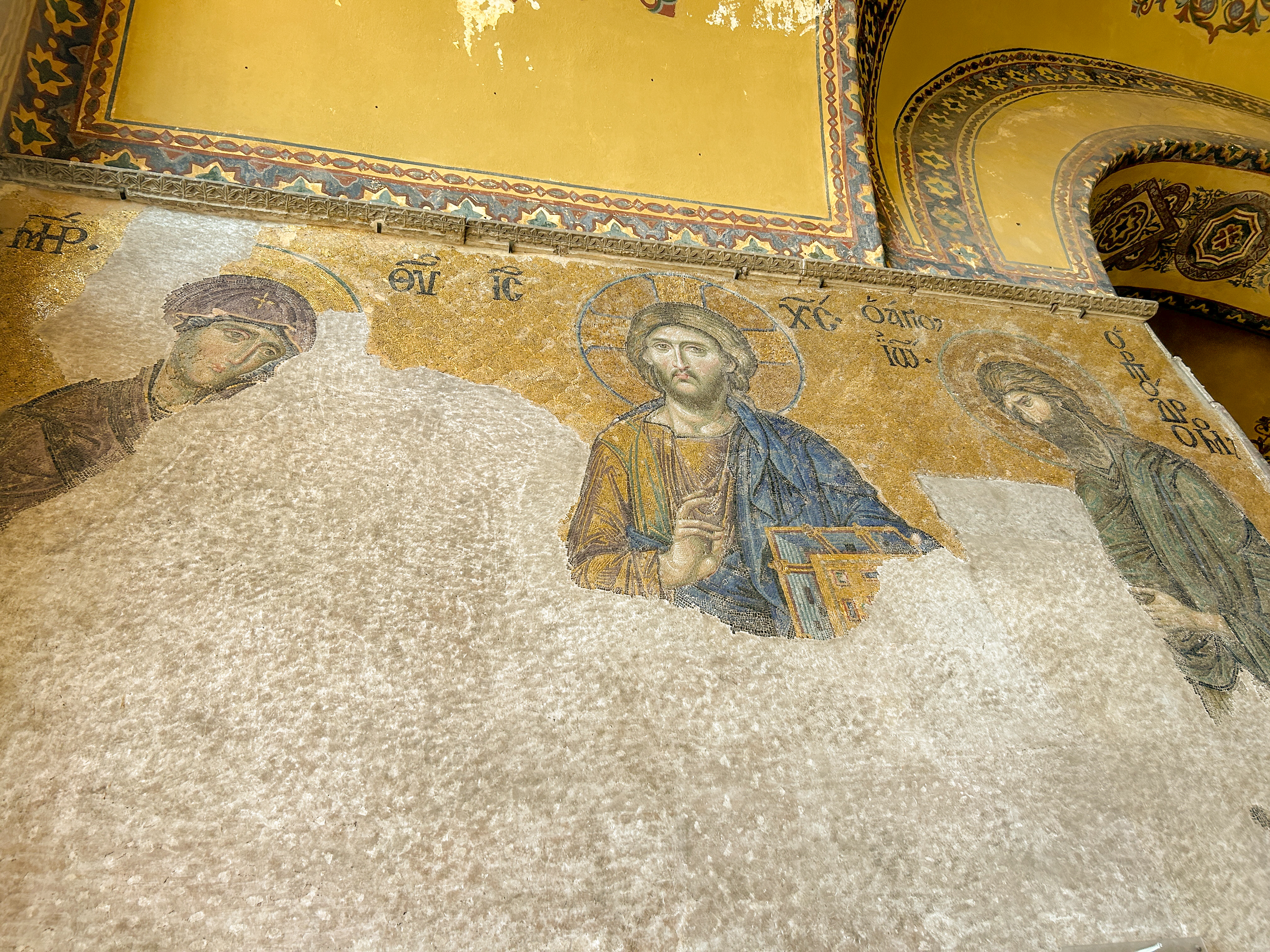
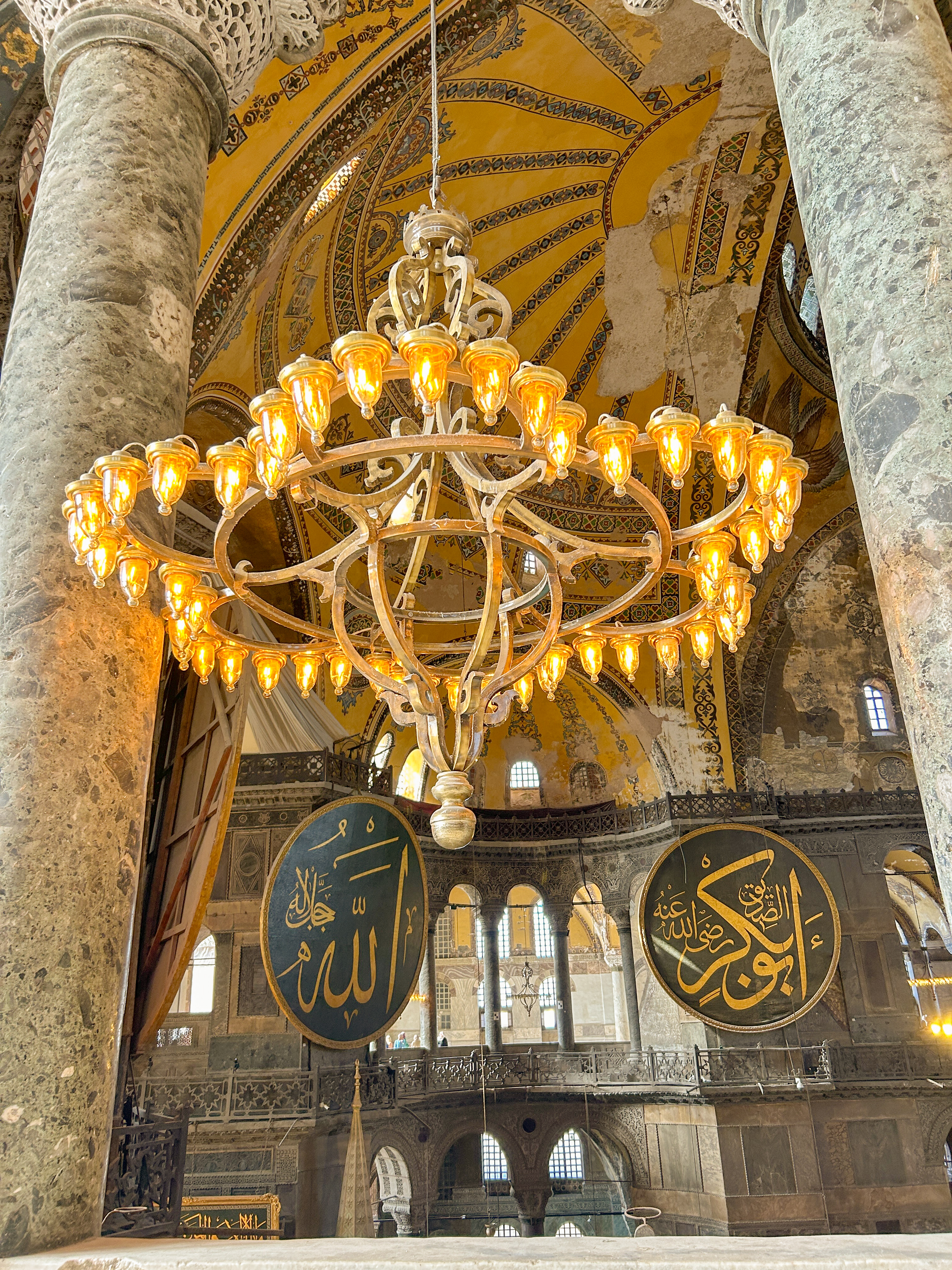
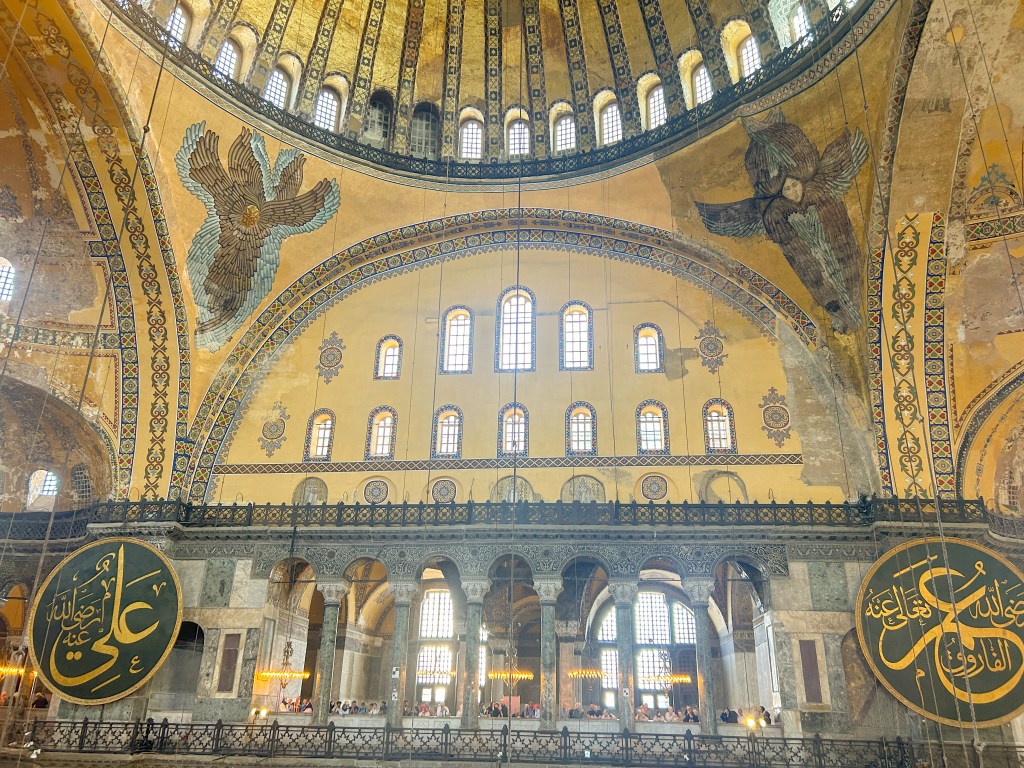
If you’d like to know more about Islam, about half-way through in the back of the mosque are volunteers that are there to answer questions and give information. I found these volunteers at all of the major mosques around the city, so you don’t need to speak to them here. But I would suggest speaking with them at some point if you want to learn more about their religion or mosques in general. They were very friendly and informative.
As you leave, you will have to head back down a separate set of stone stairs. There is one more notable point of interest. As you near the exit, on the right hand side is a large door also known as the SouthWest Entrance. Above it there is a large mosaic that features emperor Justinian I holding a model of the Hagia Sophia, emperor Constantine I holding a model of Istanbul, and the Virgin Mary holding baby Jesus.
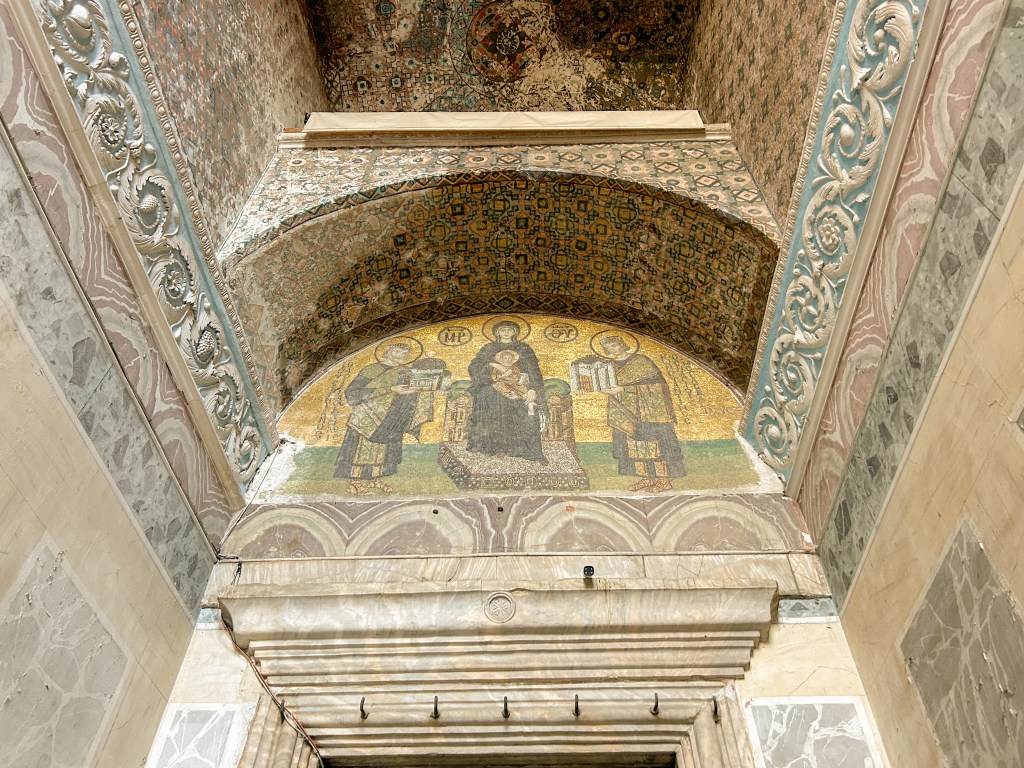
The Hagia Sophia really is amazing. When you’re walking around, think about just how old the building is. You can spend as much time as you want inside. Or as much time as you can handle other inconsiderate tourists pushing you around or asking you to move to take photos. I spent about 2 hours inside, but I would anticipate the average visit lasts 45 minutes – 1 hour.
Conclusion
Now you have all the information you need to visit the Hagia Sophia in 2024. To summarize, the key points you need to know regarding visitation change are: there is a new €25 entrance fee, tourists must enter through a separate entrance, and tourists are only allowed to visit the upper floor.






 Courtney Plans Travels
Leave a comment