
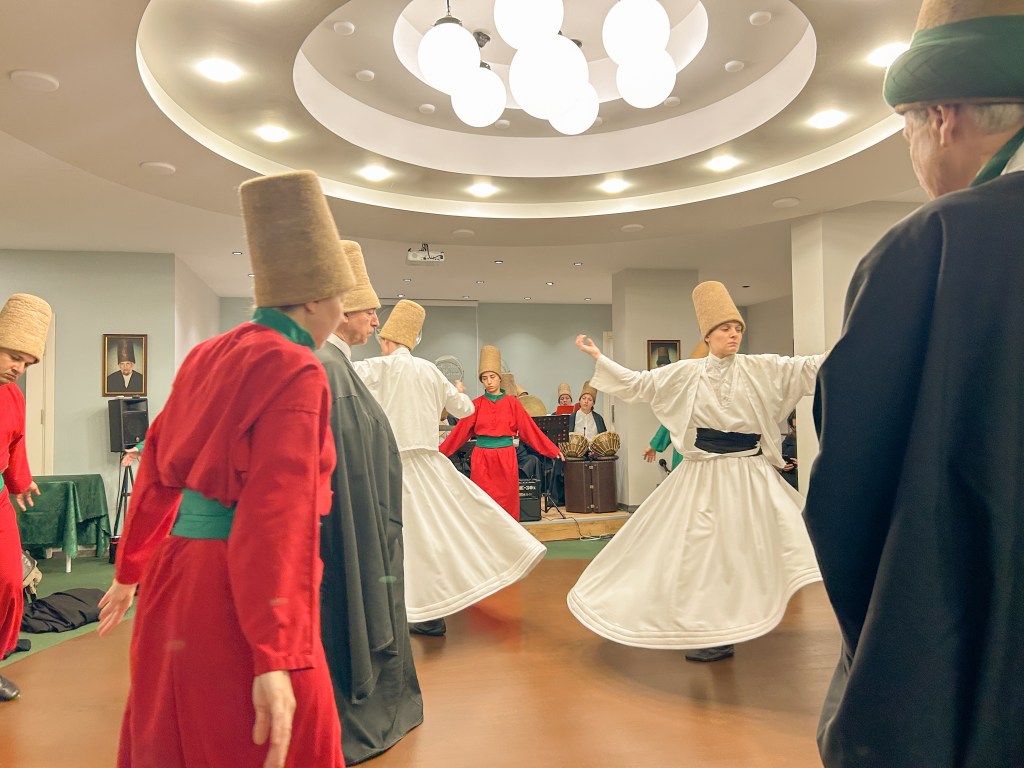
On my recent trip to Istanbul, I took a chance and booked a ticket to see a whirling dervish ceremony in a real monastery. I wasn’t really able to find any reviews on the group performing the ceremony, and I had to take their word saying it was real. I’m so glad I did because through this experience, I got a glimpse into the modern Sufi religion and saw a genuine whirling dervish ceremony.
If you’re visiting Istanbul and want to skip all the touristy performances, you should consider this authentic whirling dervish ceremony. In this post, I’ll detail my experience with the ceremony as well as practical details if you wish to view this ceremony for yourself.
- What are Whirling Dervishes?
- The Modern Mevlevi Order
- How to Book an Authentic Whirling Dervish Ceremony
- The Whirling Dervish (Sema) Ceremony
- My Thoughts on the Experience
- Conclusion
What are Whirling Dervishes?
Maybe you’ve heard of them before, or perhaps you’ve seen a photo of one spinning with their skirt waving in the wind. They’re the whirling dervishes. But what exactly are whirling dervishes?
The whirling dervishes, as they are commonly referred to, are part of a mystical form of the Islamic religion called Sufism. In Sufism, followers attempt to attain closeness to God by looking inward. The Mevlevi order, to whom the whirling dervishes belong, are a subset of the Sufi religion. The specific ceremony that gives them their colloquial name is actually called the Sema ceremony. In this ceremony, participants dressed in white outfits spin methodically in 360° rotations. The whirling is used as a form of prayer and meditation. Every aspect of the ceremony has a very specific order and purpose; from the color of the clothing worn, to the direction that the hands face when spinning. It’s all meant to symbolize stages on the path to accessing God.
The Modern Mevlevi Order
Sufism was officially banned in Turkey in 1925 under a number of reforms made by the Ottoman state. However, the Mevlevi remained secretly active and the practice ended up surviving. In the 1950’s, the Turkish government realized the cultural value that the Sema ceremony could provide in terms of tourism. For this reason, they loosened restrictions on the Mevlevi order and today the religion is tolerated, while not technically permitted.
One of the first things I knew I wanted to do when I booked my trip to Istanbul was see a Sema ceremony. I did a lot of research and tried to find an authentic way to see the whirling dervishes. I quickly realized that most of the experiences available in Istanbul are performances put on solely for tourists, as opposed to a genuine religious ceremony. Given that the Sufi religion is banned in Turkey, and that the government’s only interest in keeping it is for tourism dollars, it makes sense that this is the case.
Eventually I came across a Mevlevi monastery that performs the Sema ceremony once per week. The ceremony is run by a foundation called EMAV (Universal Mevlana Lovers Foundation). Tourists are welcomed in, but they are limited and it is not a show. This was exactly what I was looking for. So I took a chance and booked my tickets. It ended up being one of the most unique ceremonies I’ve ever seen.
How to Book an Authentic Whirling Dervish Ceremony
Where to Buy Tickets
You can book the ceremony online, in person at their ticket office, or by emailing them directly. I booked the tickets online about a week in advance with no problems. You can book tickets online here. There is also information on the website for purchasing tickets in person. When you book through the website, you will get one automated email when you proceed to checkout (which states that your order has been received) and then a second email once your payment method has gone through (which states that your order has been paid). Later that same day I received an email from Les Arts Turcs with all necessary information; reservation details, program, address, directions, etc.
The price is €35 per person, and I think it was very worth it. If you’re genuinely interested in the Mevlevi order, then you should avoid the fake tourist shows and visit this one instead.
I’m not sure if this is a ‘popular’ ceremony to purchase tickets for, but I will say that it’s very small with a limited number of seats for tourists. And I know that they only let a certain number of tourists in, since it is a religious ceremony. So if it’s something that you are very interested in going to, I would book it in advance to make sure you get to go.
Dates and Times
The shows only happened once per week on Thursdays starting at 20:30 in the evening. The ceremony lasts approximately 2 hours but it’s variable and subject to change.
Dress Code
There is no dress code for entering the monastery. Personally, I would dress more conservatively in Turkey in general. But you do not need to wear a head covering or anything to get in. From what I understand, there is a rule of tolerance in the Sufi religion and there is no dress code for their followers.
Photography
You are allowed to take photos and videos on your phone or camera. But any sort of professional photography or videography is not allowed without special approval.
How to Get There
The website itself does not state where the monastery is, you only receive this information after booking. For this reason, I will not put the exact location. I will say that it takes about 25-30 minutes via the tram to arrive at the monastery from the central tourist area around Sultanahmet square. The location that they send you on Google Maps is correct, even if you don’t see it right away. You have to go through a little passage, where there is a barber shop, and then through a door and down some stairs. So allow yourself enough time to arrive and find the location.
The Whirling Dervish (Sema) Ceremony
Arriving at the Monastery
When we arrived, I didn’t know what exactly to expect. The program for the night stated that we could arrive at 19:30 to watch a video discussion about the Mevlevi path so we did. Once we found the location, we went down the set of stairs and took off our shoes. We provided the woman at the desk our names and reservation number and she led us to our seats. We were given a pamphlet and an informative paper that explained a bit more about the Mevlevi order and the ceremony that would take place.
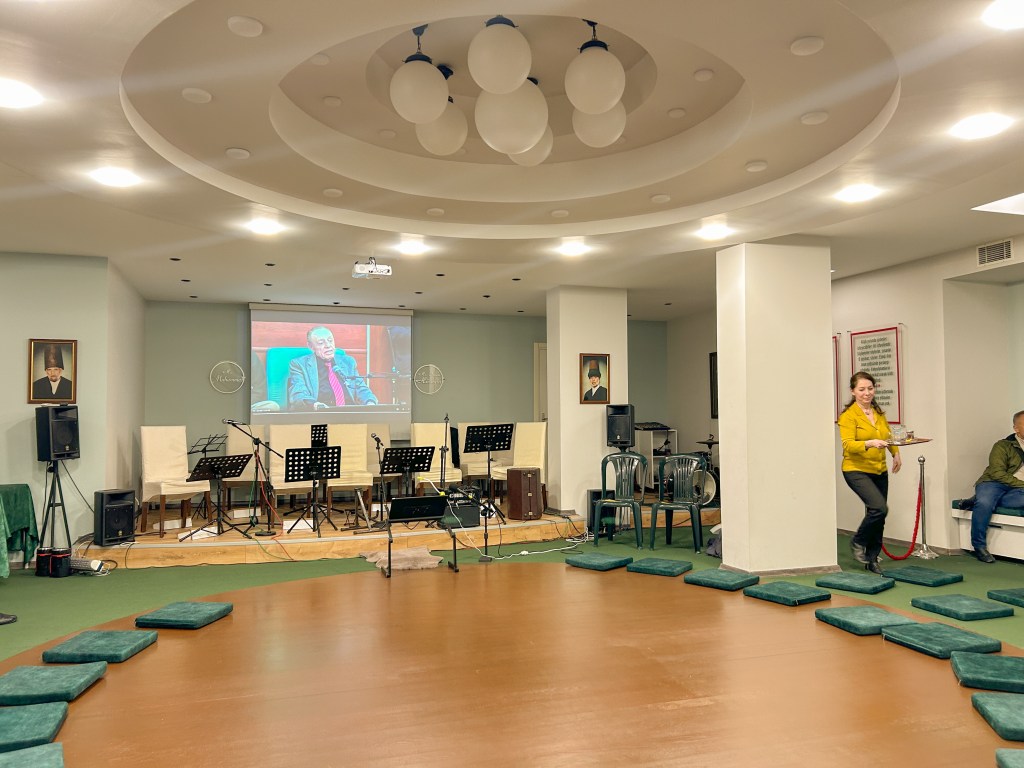
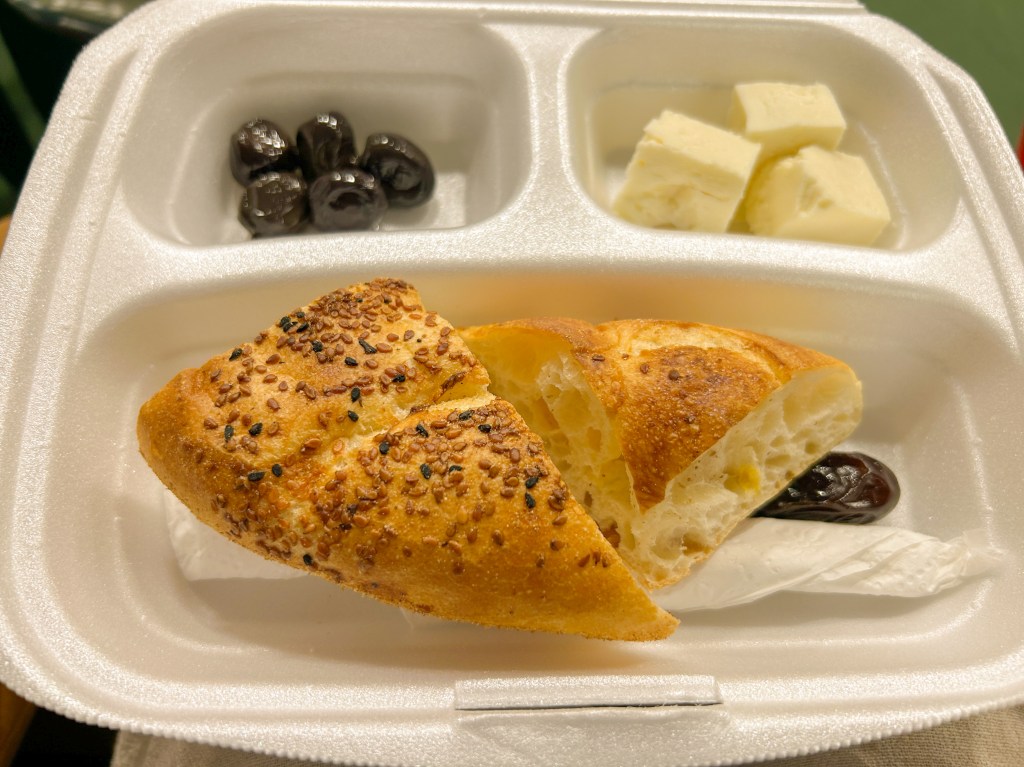
There were a couple of other tourists already there. But there were also plenty of locals that I assumed would be partaking in the ceremony. They were all catching up and breaking their fasts. We were in Turkey during Ramadan and around 19:30 was Iftar time. We were actually given the Iftar snack boxes, which had some bread, dates, olives, and cheese, as well as some Turkish tea. Everyone we encountered was very kind and welcoming. Before long, the video discussion was put on. More and more people gradually arrived into this little basement monastery – mostly locals who all knew each other, and some tourists here to watch. In total, I think there were about 20 tourists in the crowd and everyone else was participating or following in one way or another.
The Mevlevi Dhikr
Around 21:00, there is a Mevlevi dhikr, or remembrance of God. In this portion, all of the participants in the room moved to the wooden floor and made a circle on the floor. Everyone sat on their knees on padded cushions. There was someone who read/sang, a flute and hand drum, and some chanting by all of the participants. Near the end someone even got up and started spinning. At this point everyone is participating in some way and they’re all in regular clothing.
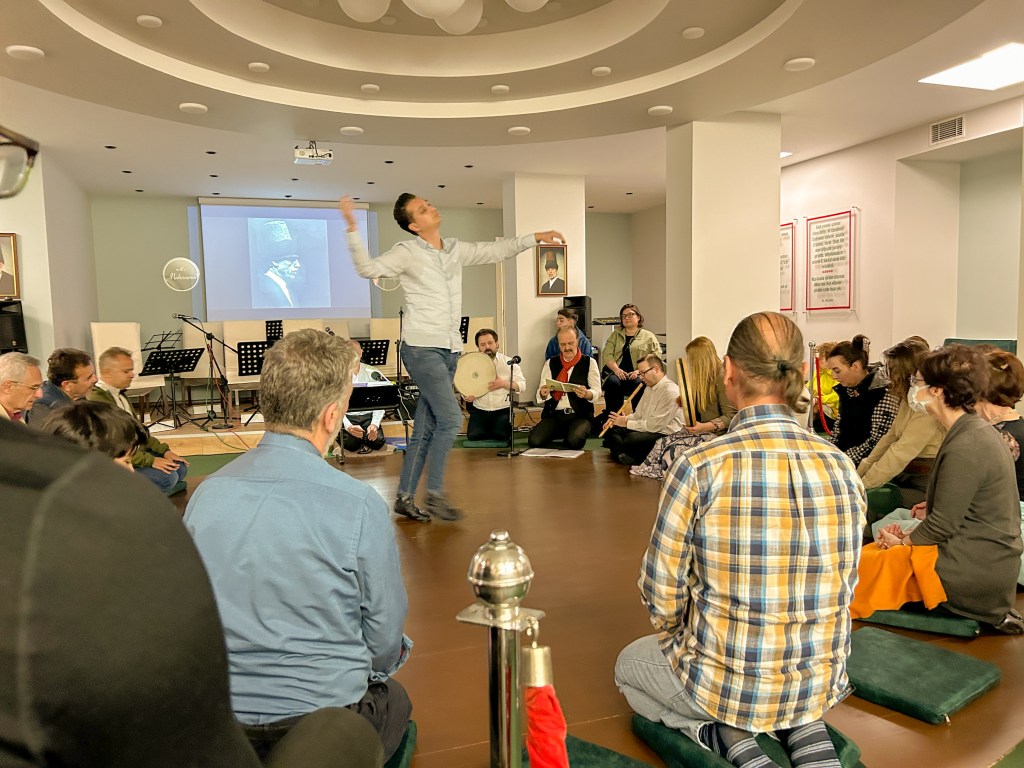
This lasted for around 30 minutes. Everyone participating left the floor and then we were served Dervish foods. There was yogurt, puff pastries with fillings, and even some lokma! I wasn’t expecting there to be food, so it was a pleasant surprise. This time served as a quick break before the Sema ceremony began.
Beginning of the Sema Ceremony
At around 21:45 everyone came into the room in new outfits. One member, the dervish chief / dance leader, came to the back of the room and carefully placed a red sheepskin on the floor. All members were wearing black cloaks on top of their outfits with tall brown hats. A number of people sat in seats at the front to play musical instruments. The rest all sat on one side of the wooden floor. The ceremony was ready to begin.
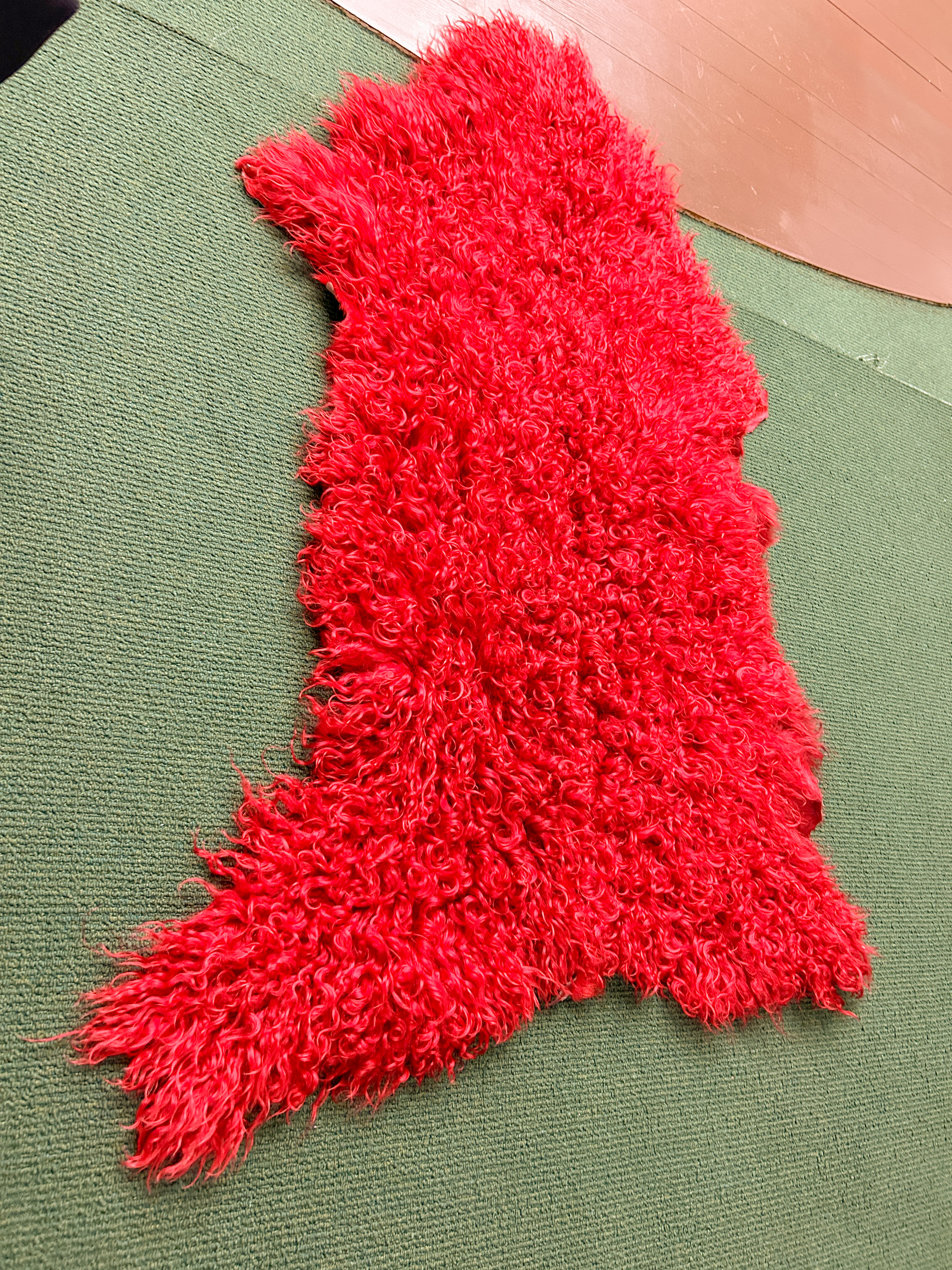
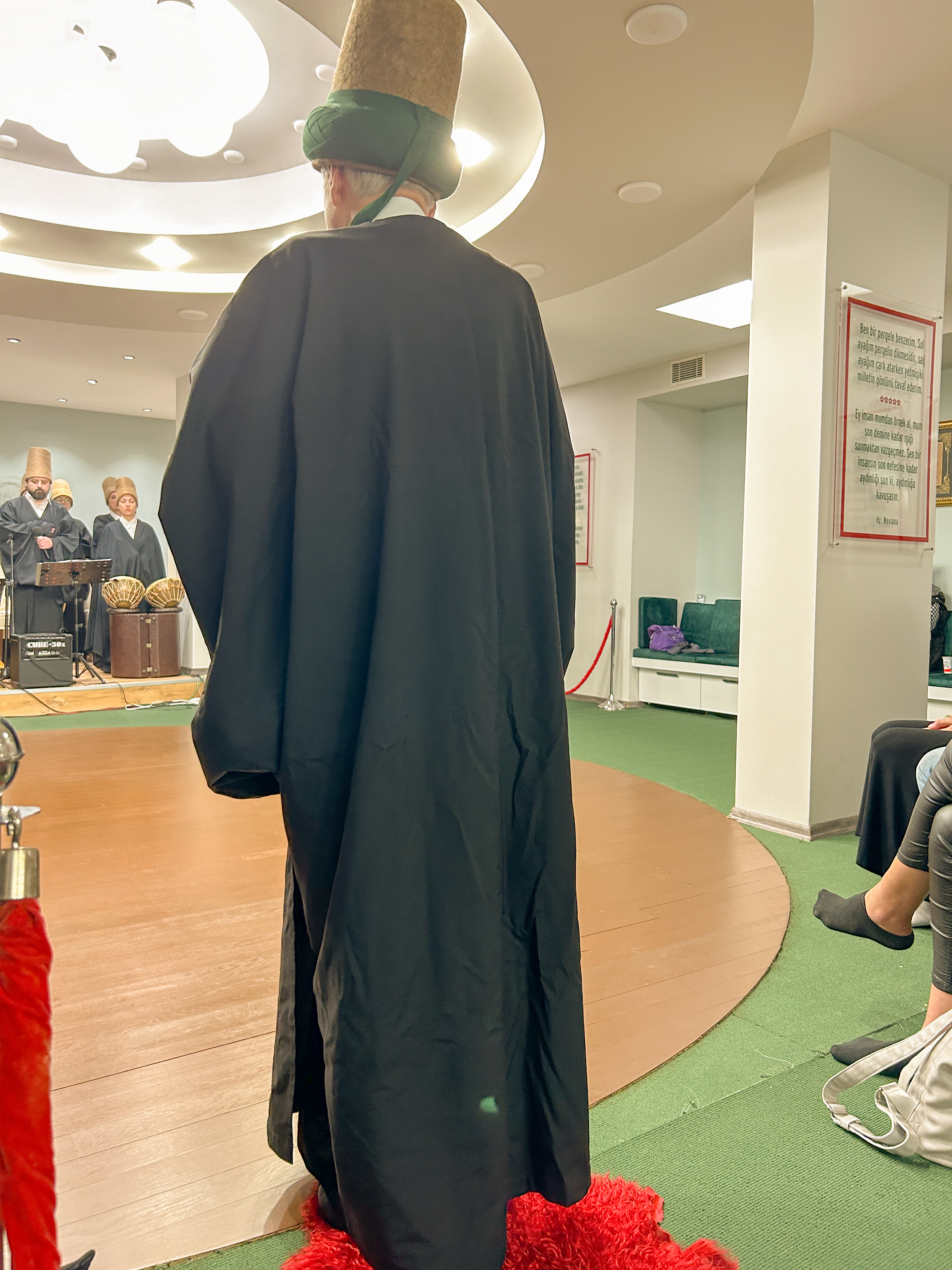
The Sema (whirling dervish) ceremony consists of the following parts: the noble eulogy to the Prophet Mohammed, a flute solo, a prelude, the Circling of Veled and four segments (selam). First, someone chants a prayer and a chapter of the Quran out loud. There is then a solo by the flute and the musical prelude begins. From here on out, the music continues for the entire ceremony.
The Circling of the Veled
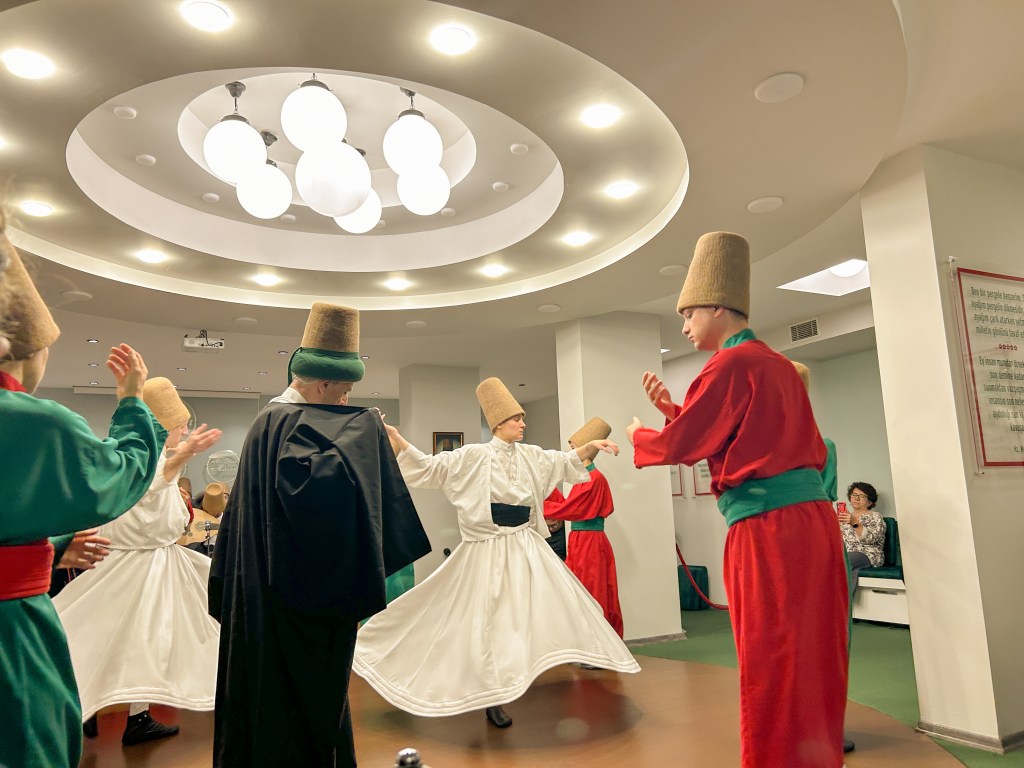
The Circling of the Veled is a very interesting portion of the ceremony and lasts for quite a while. The dervishes all form a circle, in a very methodical way, behind the sheikh. The sheikh is the person who leads the ceremony and who is typically at the back where the sheepskin is. They keep moving in a counterclockwise circle and each dervish stops to bow at the dervish behind them when they reach the sheepskin. After they circle the room a certain number of times, they go to their positions. Here, they remove their black cloaks to reveal three colors of clothing. There are people in mostly red (with green accents), mostly green (with red accents), and two people in all white. The ones in white are the ones who will be spinning.
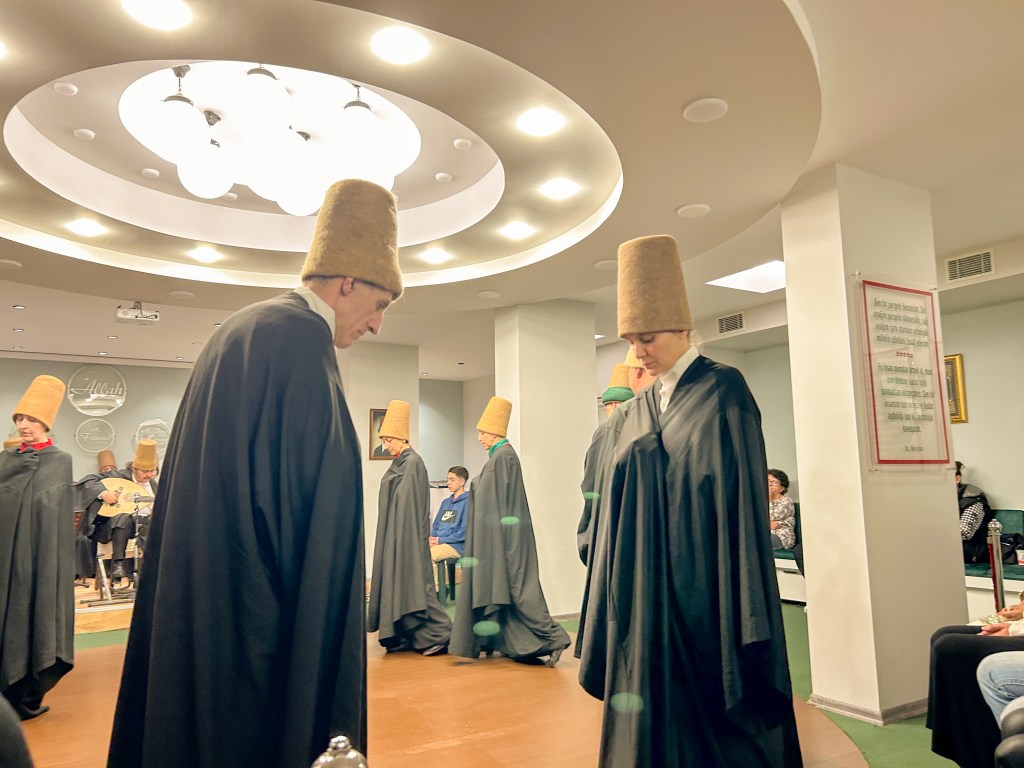
Whirling of the Dervishes – The Four Semas
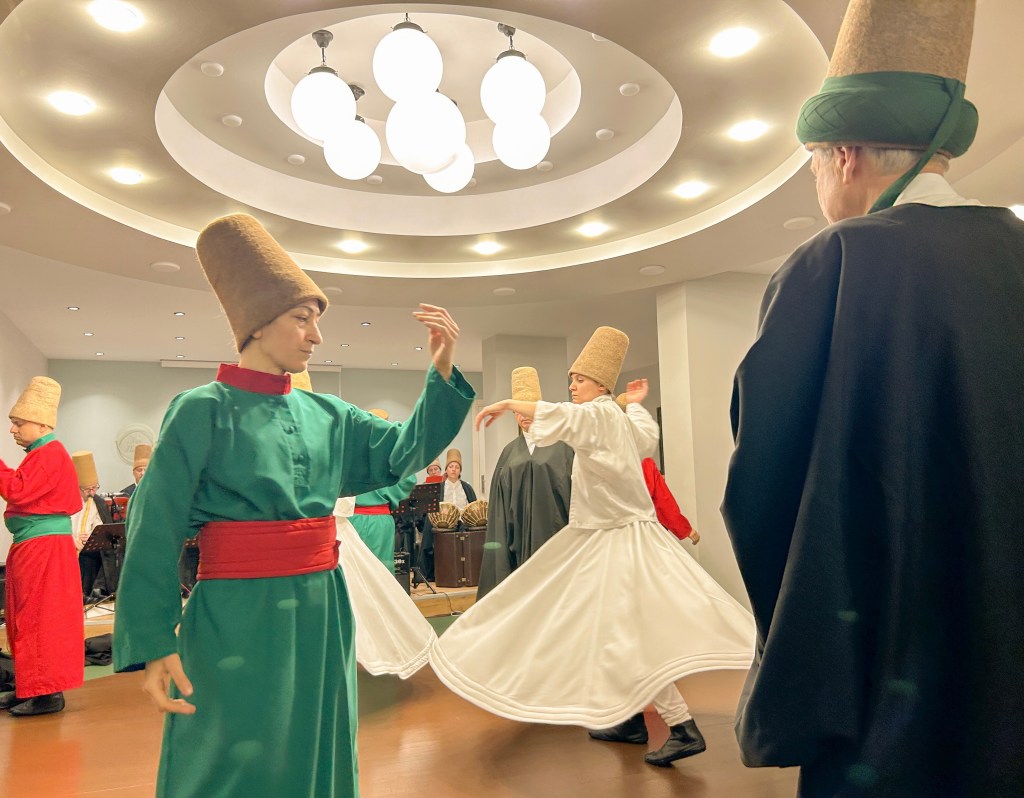
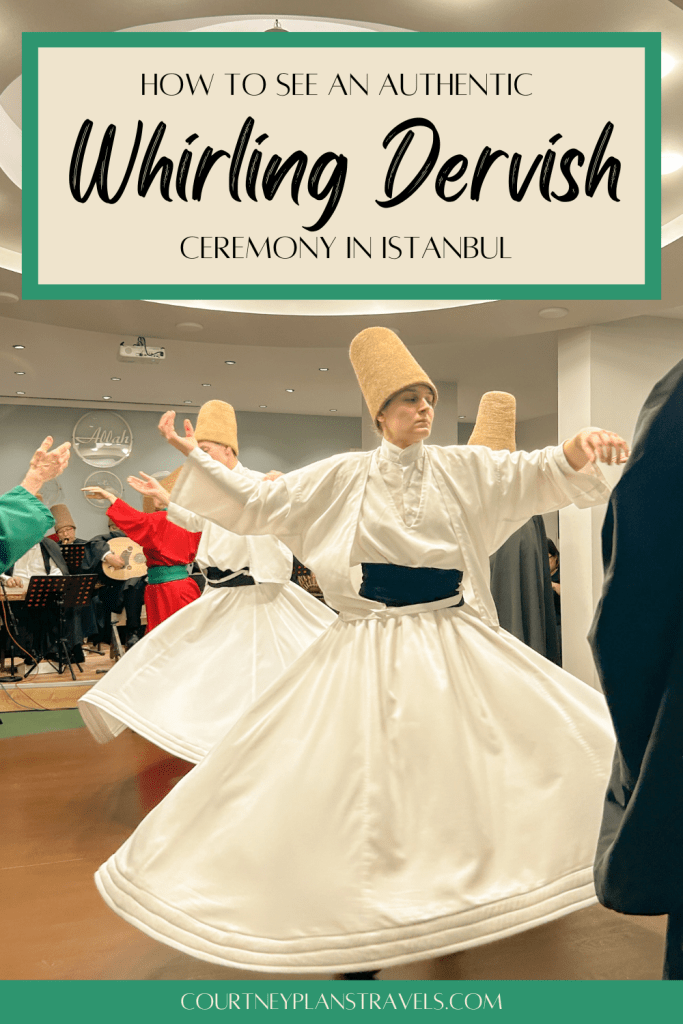
From here on out is the portion where you will see the whirling dervishes spinning. Those who are wearing colored robes walk on the outskirts of the circle and perform specific movements. When they reach the sheepskin, and the sheikh, they bow. While this is happening the two dervishes in white begin spinning in the middle. Both arms are held out with the right hand facing up and the left hand facing down. As they spin they are silently reciting “Allah, Allah” in their heads after every rotation. Their skirts flow so beautifully in the wind they create. While this is happening, the dervish chief is carefully watching the spinning dervishes to make sure they maintain proper distance, speed, etc. It’s really amazing to watch all these components coming together; the music, the bowing, the spinning. There is a lot going on and it’s all extremely methodical – not to mention difficult.
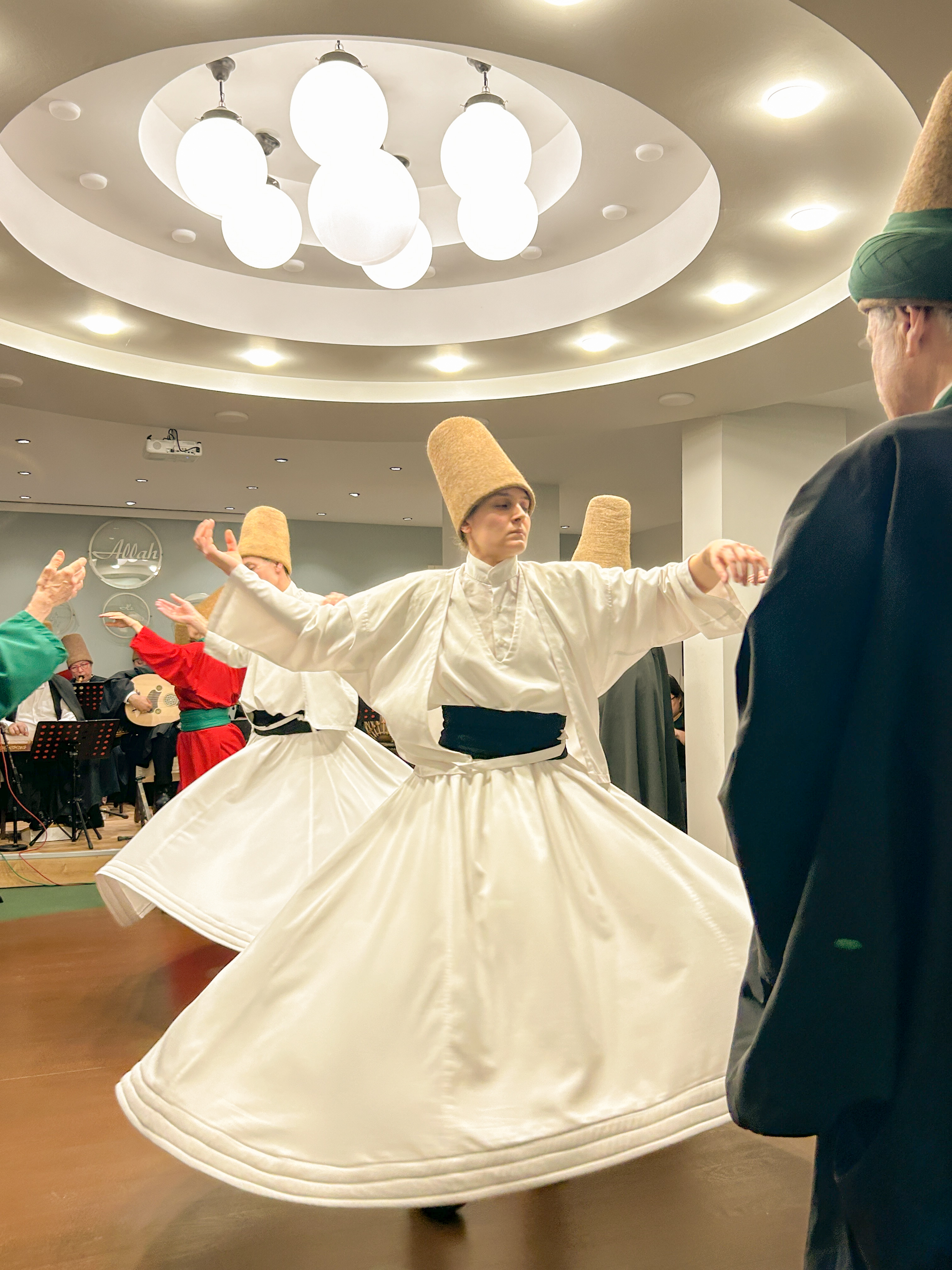
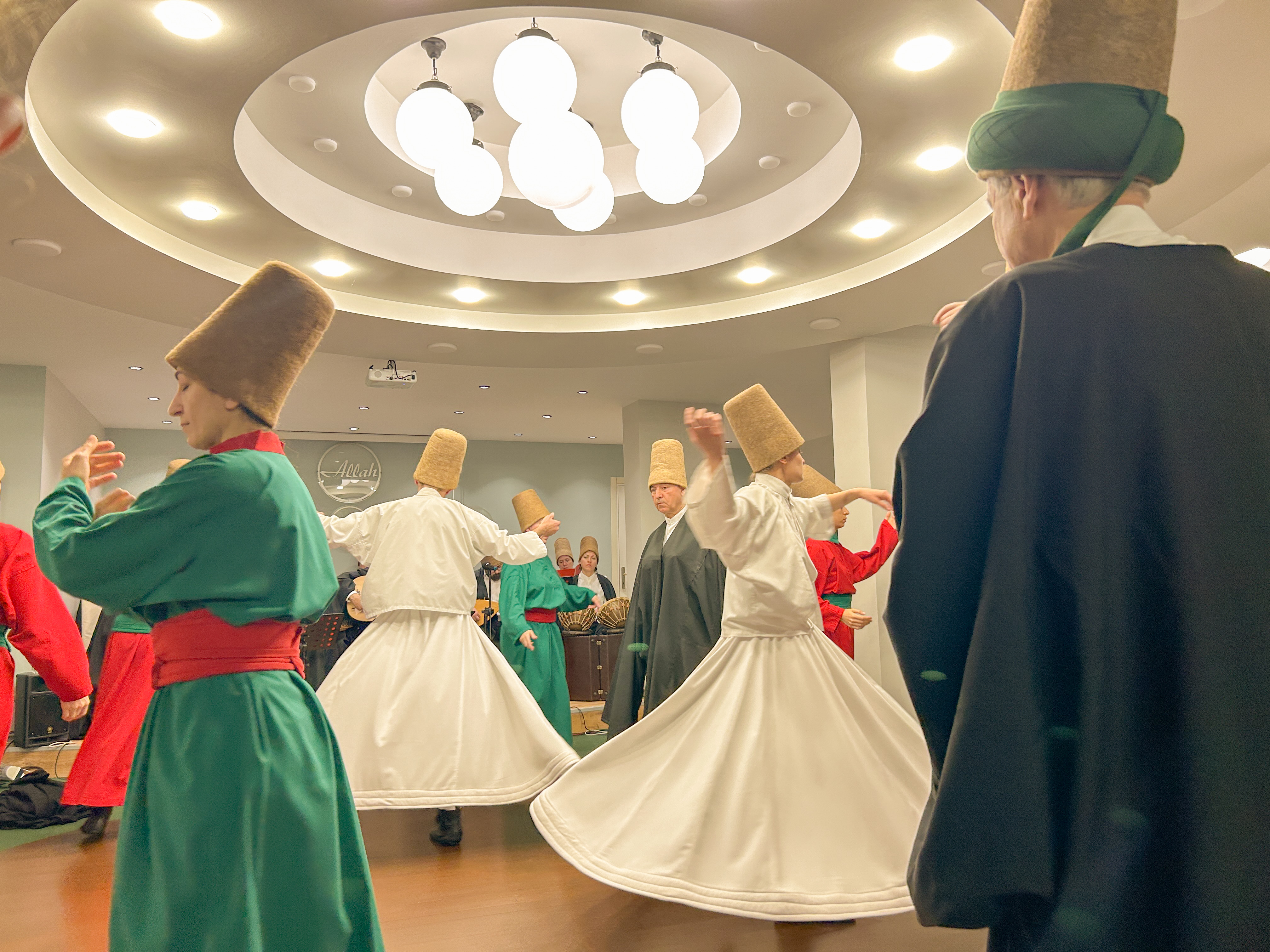
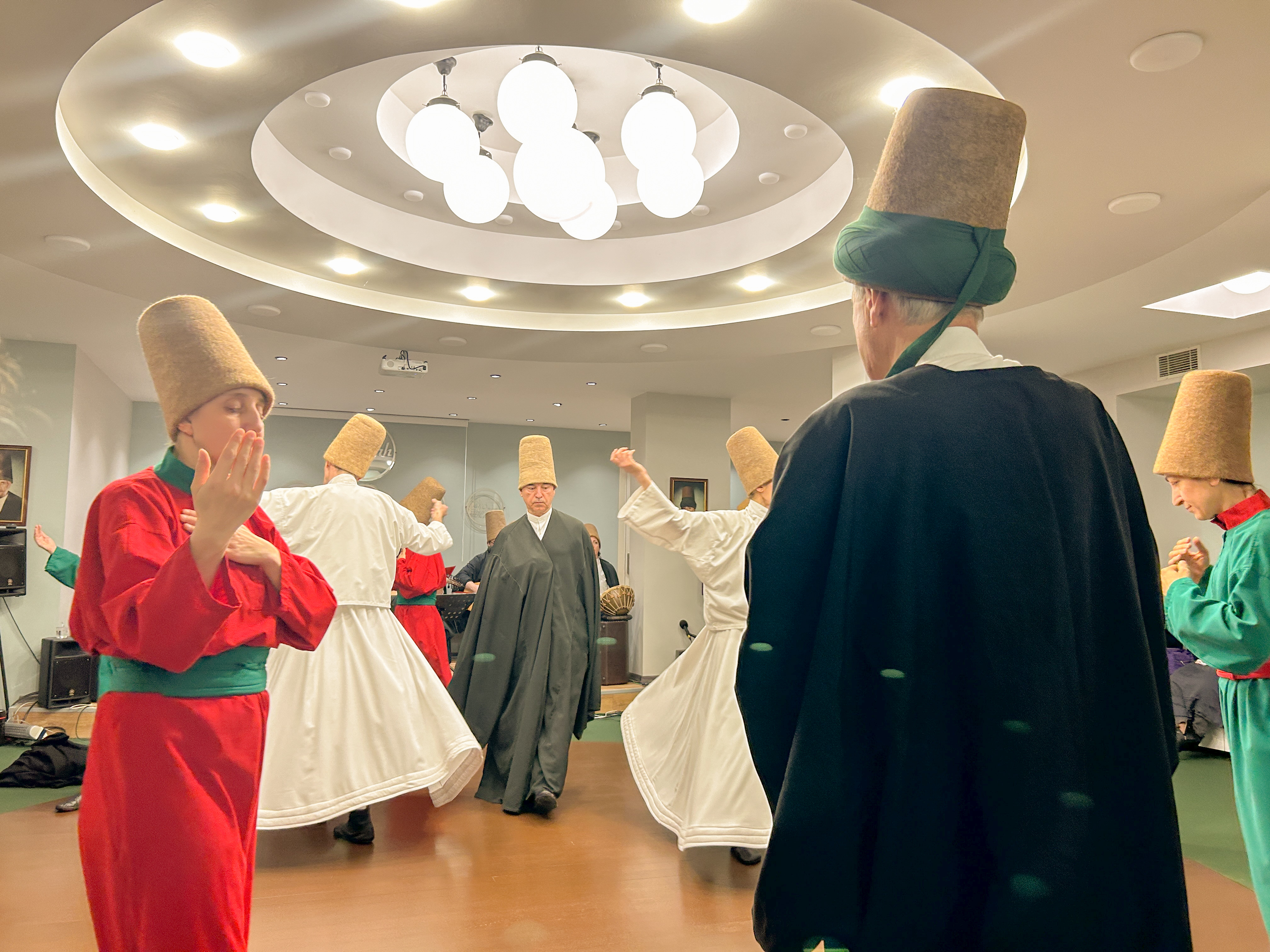
This goes on for about 10 minutes before the music stops and the whirling dervishes halt. It’s very impressive how abruptly they are able to stop and maintain themselves steadily in one spot. They don’t look the least bit dizzy and barely show signs of being out of breath. This is the end of one selam. There are three more selams after this one. The last selam is slightly different and then there are a couple more steps before the ceremony is officially over.
My Thoughts on the Experience
This was one of the most interesting cultural experiences I’ve had the privilege to witness. I genuinely believe it was an authentic ceremony that would have happened whether tourists were there or not (though I have no way of really knowing). Just based on what I saw, I’m pretty sure that everyone who participated follows the Sufi religion in some way. I feel very lucky that this group was kind enough to welcome tourists into such an intimate practice. I learned so much about something I had very little prior knowledge on. While the €35 price point is high for a budget traveler, I think it’s worth the money. Considering how expensive a lot of other tourist attractions are in Istanbul (ex:// Topkapi palace is €43), I think this one is worth the investment.
We spent about three hours here in total. I think it’s the perfect cultural immersion. If I had gone to a cheaper, more popular dervish ‘show’ it would have been just that, a performance. It wouldn’t have been impactful or very meaningful. I feel like through this experience I was able to gain an insightful lens into someone else’s religion and life. I would highly recommend supporting this monastery and experiencing their ceremony for yourself.
If you’d like more information about EMAV, the foundation that runs the ceremony, you can access their website here.
Conclusion
If there’s only one experience or activity that you have in Istanbul, make it this authentic whirling dervish ceremony. The Mevlevi order has such an interesting history and religious culture. I think it’s well worth spending the time and money to immerse yourself in their world for an evening.
Sources
Admin. “The Mevlevi Order.” The Threshold Society, 29 Jan. 2017, sufism.org/origins/mevlevi/the-mevlevi-order-2.
“What Is Sufism?” The Threshold Society, 2 Oct. 2023, sufism.org/sufism.
“Sufism in Turkey.” Religion and Public Life at Harvard Divinity School, rpl.hds.harvard.edu/faq/sufism-turkey#:~:text=Despite%20reforms%20that%20dissolved%20Turkish,and%20flourishes%20in%20Turkey%20today. Accessed 30 Apr. 2024.




 Courtney Plans Travels
Leave a comment