
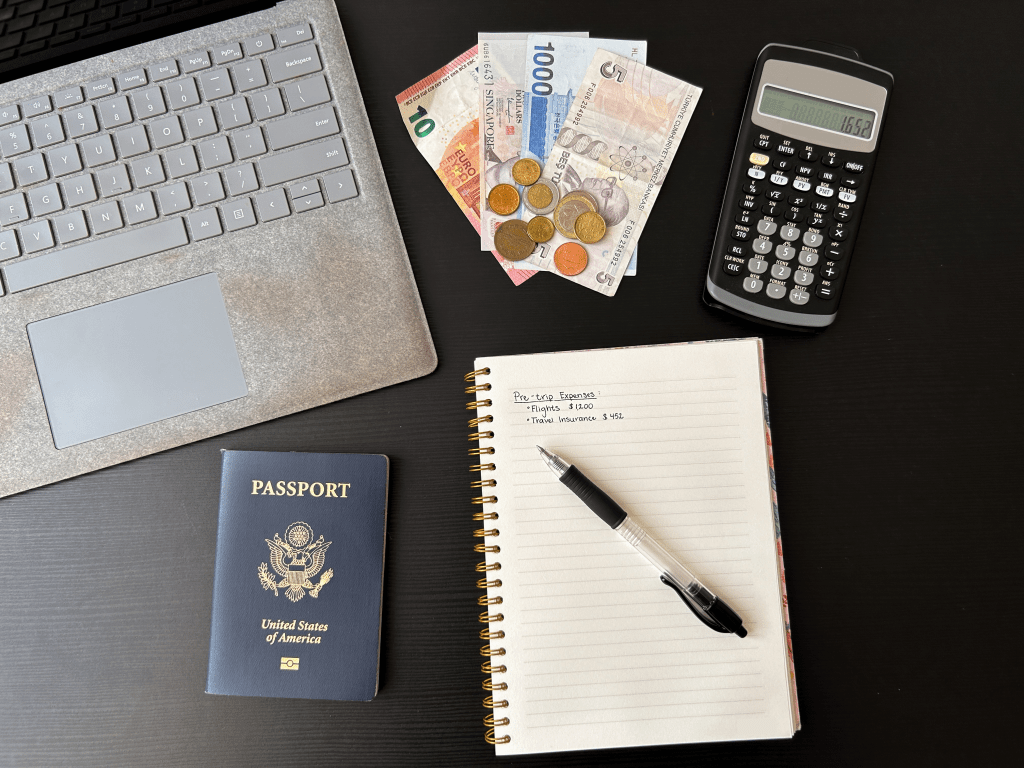
If you’re planning a long-term trip, the first thing that logically comes to mind is probably money. Creating a realistic budget is one of the most important steps in planning a trip. How much does it cost to go on a long-term trip? What kinds of expenses do I need to plan for? How much money do I need to save up in advance?
There are a lot of aspects that you have to consider when it comes to budgeting for a long-term trip. In this post you’ll find all the information you need to create a budget for your trip and a savings goal so that you can make your trip a reality. Read through to the end for a useful freebie for planning your budget!
But before you get on with reading this post, I would suggest checking out my other posts: Planning a Long-Term Trip: Everything you Need to Know, and How to Research your Travel Destination to further guide you in your trip planning journey.
- General Tips for Planning a Trip Budget
- Expenses to Include in a Travel Budget
- How to Research Costs in your Destination
- How to Calculate your Total Budget
- Free Budget Calculator Spreadsheet
- Conclusion
General Tips for Planning a Trip Budget
Before we get into the nitty gritty of budgeting for a trip, I want to give you some generic tips for planning your budget.
- It’s better to overestimate than to underestimate expenses. This will leave you with a buffer in case something costs more than you anticipate, you need to unexpectedly change your travel plans, or any other unforeseen circumstances come up.
- Don’t worry about estimating the exact accurate cost for every item in every category. The goal here is to get a ballpark estimation of the cost for each aspect of your trip. This will enable you to save up a realistic amount of money and make your trip a reality!
- If you don’t know the specific countries you’ll be visiting or it’s too overwhelming for you to research costs for each individual country, then use the travel region for your estimates. It’s pretty easy to find average daily cost estimations for regions such as Southeast Asia, Central America, or Western Europe.
- Personalize your budget. You know yourself and how you prefer spending your money better than anyone else. Make sure you take into consideration the things you do and don’t want to spend your money on during your trip. It could make a big difference in how much you need to budget.
Expenses to Include in a Travel Budget
When you plan a long-term trip there are a couple categories of expenses you’ll need to consider.
Firstly are your pre-trip expenses. These are one-time expenses that you incur prior to leaving on your trip. Many travelers forget to consider these expenses and blow through a large portion of their trip money before they ever step foot on an airplane. These expenses can add up quickly and vary significantly from person to person, so take the time to list out all the pre-trip expenses you think will apply to you.
Below are the pre-trip expenses you should budget for. They’ve been broken up into essentials and non-essentials.
Essential Pre-Trip Expenses
- Flights ($700-$1,200): Whether it’s a one-way, roundtrip, or two one-way tickets, these are your flights to (and possibly from) your intended destination. I would overestimate here to anticipate the worst. But if you plan far enough in advance, you can track flight prices and snag a good deal when it arises. Another option is to open a travel credit card with a good introductory offer. The points you earn from this could pay for your flight.
- Travel Insurance ($150-$650): Travel insurance covers you for worst case scenarios during your trip. Don’t travel without it! The cost of travel insurance is based on factors such as coverage type, country of residence, age, where you’re traveling, and for how long. It’s easy to visit popular travel insurance websites, put in your info, and get a quote.
- Travel Vaccinations & Medications ($500-$1,500): This cost will vary depending on what vaccinations are required for your destination, as well as what vaccines you opt in to. You should also include the price of a consultation for a travel medicine clinic in your budget. If you purchase any medications such as malaria pills or anti-diarrhea include the cost here.
- Visas & Passport ($20-$300): If you need to purchase a passport, then this will be on the higher end of the scale. Make sure your passport is valid for at least 6 months from the end of your trip and has plenty of blank pages. Visa fees can vary greatly depending on the country you’re entering and your nationality. You also need to carry extra passport photos with you during your trip for visas while on your trip. Factor in this cost here.
- Backpack ($100-$300): If you already have a backpack, then you’re set. Otherwise this will be one of the larger investments on your list. It’s probably the most important piece of gear you’ll have. If you plan far enough in advance, you can keep an eye out for sales. Another money saving option is to buy a used backpack.
Non-Essential Pre-Trip Expenses
- Toiletries & Other Supplies ($20-$100): You might want to stock up on toiletries that would be hard to find abroad before you leave. I would also include things like sunscreen, insect repellent, and a first aid kit in this section.
- Gear & Clothing ($50-$400): I want to make it clear that you do not need any sort of fancy gear or clothing to travel. Yes there are things that might make your trip slightly more convenient, such packing cubes or a filtering water bottle, but these are extraneous items. You don’t need to spend money on these things. Lots of people will try and tell you otherwise but they will not be the difference between a good or bad trip. Plus, less is more when you’re carrying all your belongings on your back.
Trip Expenses
The second category of expenses to include in your budget are the actual trip expenses. These are all the expenses that you will be incurring on a regular basis during your trip. These are things such as food, accommodation, and activities. You will need to do research on the destination you wish to visit in order to estimate how much these expenses will average. I suggest using average daily costs in this section.
Below are the trip expenses you should budget for. They’ve been broken up into daily expenses and other non-daily expenses.
- Accommodation: Where will you be sleeping? If you’re on a tight budget, are a solo traveler, or it’s your first backpacking trip, I would suggest staying in hostels. Hostels are the cheapest type of accommodation and allow you to meet other backpackers along the way. You may want to budget a little extra to be able to stay in private rooms every once in a while.
- Food & Drinks: What types of food will you be eating? You should consider whether you’ll be eating more street food or more sit-down restaurant types of food. The former is cheaper than the latter. If you don’t have a filtering water bottle, you’ll likely have to purchase water bottles your entire trip (depending on your destination). Also think about if you’re planning on drinking a lot of alcohol. This will require an increased budget.
- Transportation: What kinds of transportation will you be using? The types of transport you use can affect your budget quite a bit. Will you be taking mostly buses or trains to go long distances? Or will you pay extra to take a flight? Will you be renting a motorbike frequently or taking a lot of tuk-tuks? There’s almost always a trade-off between time, money, and comfort in this category.
- Attractions: What kinds of attractions do you enjoy visiting and how frequently will you visit them? Attractions include places such as museums, historical sites, churches or temples, etc. Consider if the attractions you want to visit have entrance fees or are mostly free. Another factor that will affect your budget here is if you choose to DIY your sightseeing or if you plan to take a lot of packaged day tours. There are some places where you have no option but to take an organized tour. But if you want to save money, and in my opinion have a more unique experience, then I would try to avoid package tours as much as possible.
- Activities: What activities do you want to participate in and how frequently? The cost of activities varies a lot from person to person. So you can use an estimate based on the research of your destination. However, if you have a particular interest that you plan to engage in frequently, such as diving, you might want to estimate this as a separate expense. You most likely won’t be doing activities every day, but you’ll want to participate in activities such as cooking classes, hiking tours, etc., on a semi-regular basis.
Other Trip Expenses
- Flight Home ($700-$1,400): Don’t forget this one! If you purchased a one-way flight then you need a flight to get home. You’ll probably be purchasing this much closer to the date of the flight so it will be more expensive. Again, overestimate this just in case!
- Emergency Fund ($1,000+): If you already have money budgeted for a flight home, then this money is to make sure you can afford an emergency situation. You never want to be stuck in a dangerous situation because you don’t have enough money to get out of it. There’s no right amount for this but I like to have a good buffer because you never know what’s going to happen.
- Expenses from Home: Depending on your situation, you may still be incurring monthly expenses at home. These would include items like rent/mortgage payments, phone bills, internet bills, etc. You might not need to necessarily include these in your trip budget, but you shouldn’t forget that you’ll still be paying them every month.
How to Research Costs in your Destination
A large portion of your budget is going to be determined by the “trip expenses” category. This category will vary depending on where you’re going and how long you’re going for. If you know the specific countries you want to visit, you can look up daily cost estimates for each country. If you only know the region you want to visit, you can do the same for a region. Looking up regional costs might be a little less accurate than per country costs, but it should be good enough to get you a realistic budget.
Online Resources
In order to find information on average daily trip costs, you can do a quick online search and yield pretty accurate results. Try searching “average daily travel costs in _______”, where the blank is either a country or region. Usually online sources will bunch daily costs into three categories of travelers; budget, mid-range, and luxury. Make sure to consider these classifications when you choose a number to go with.
Guide Books
Another great resource for estimating costs are travel guide books. I’ve said before that a good way to save money on guide books is to buy them used and outdated. If you use a travel guide that is more than a couple of years old, take the budget recommendations with a grain of salt. Currency exchange rates, economic strength, and inflation can change a lot in a couple of years so some outdated travel guides may be inaccurate. I would suggest referencing your guide book and comparing it to more recent information that you find online.
How to Calculate your Total Budget
Information you need to calculate your budget
You need to know the following in order to estimate your budget:
- Where you are going – either a region or specific countries
- How long you are going for
- What kinds of transportation you’ll be using
Steps for calculating your budget
Now that you know what to include in your budget, you need to actually create the budget!
- Do research on all the pre-trip expense categories you need to be able to estimate costs for (ex:// average flight prices to your destination, visa fees, vaccinations, etc.).
- Add up all of your pre-trip expenses and set that number aside.
- Do research on the countries and/or region you plan on visiting to get estimates for average daily prices as a backpacker.
- Calculate your average daily costs for trip expenses either by country or region. Multiply these daily costs by the number of days you anticipate being in each country/region. Set this number aside.
- Estimate your other trip expenses that won’t be incurred daily. If they are recurring expenses, multiply them by the amount of time you’ll be on your trip. Set this number aside.
- Add up your estimates for pre-trip expenses, daily trip expenses, and other trip expenses. This will be your total estimated budget!
Free Budget Calculator Spreadsheet
I know that estimating a budget for a long-term trip can be difficult and time consuming. So, to help you plan out your expenses more easily, I have created a free travel budget calculator spreadsheet. It includes a sheet for estimating your budget, a sheet for determining trip details if you already have a predetermined budget, and a pre-trip expenses tracker. I’ve made comments with instructions in each of the cells with a yellow triangle in the corner. Get access to my free travel budget calculator spreadsheet here! All you need to do is open the Google Sheet, click “File” in the top left-hand corner, and then “Make a Copy”. An editable copy of the sheet will now be in your Google Drive. You can use it to plan out your budget to your heart’s content!
Conclusion
Creating a realistic budget is an essential step in making your long-term trip a reality. Taking the time to do research into each trip expense category will allow you to get an accurate picture of how much money you need to save up. You can use my free travel budget calculator to easily organize and add up your expenses. This will get you one step closer to making your dream long-term trip a reality!




 Courtney Plans Travels
Leave a comment