
Welcome to my How to Plan a Long-Term Trip series. I believe that planning in advance can save you a lot of time, money, and hassle so you can better enjoy your trip when you’re on it. That’s one of the reasons I started this series. In these posts, I lay out all the details you need for planning a long-term trip.
Today I’ll be going over how to plan out a route for your travels. This step can become complicated very quickly due to the flexibility of a long-term trip and taking into account things like budget, timelines, and desired places to visit. But it is do-able. And it is an important aspect of your trip planning to consider.
- Overview of Travel Routes
- Goal for Planning a Route
- Prerequisites for Planning a Route
- Logistics to Consider when Planning a Route
- Planning the Route
- Conclusion
Overview of Travel Routes
Planning a route is when you make an outline of all the places you want to visit, how long you want to visit them, and in what order to visit them. For trips that only last a week or two, this is fairly straightforward. Most people won’t think much about it except booking a train ticket or flight. But for someone who is planning on taking a long-term trip, say 4 or 5 months, this is a much more difficult task. For one, there are a lot more places that have to be incorporated in the route. Further, there are many aspects, such as weather and visas, that will alter the timing and order of the planned route. All of this put together can make planning a route a real chore. It may seem impossible even. With this guide you will have all the information you need to plan your own long-term trip route with as little hassle as possible.
On a related note, if you haven’t already, I would suggest doing at least a little research into where you want to visit before you attempt to plan a route. I speak about it later in this post, but if you want more detailed information on how to research your travel destination, check out my post here.
Goal for Planning a Route
The goal when planning a long-term travel route is not to have a strict six month itinerary down to the week or day. That’s simply not realistic, and it’s certainly not fun, even for an extreme planner like myself. The goal here is to have a flexible outline of the route you want to follow in the region you want to visit. This will be a realistic route that hits most of the major places you want to visit and that fits in your timeline and budget.
Ideally, when you’re done planning your route, you can say that you plan on spending ‘X’ number of weeks or months in ‘X’ country. You’ll also know the general area/city that you plan to enter the country through and the general area/city that you plan to leave the country from.
Obviously, plans change. During your trip you might:
- Realize that there’s not as much to do in a certain area as you thought
- Get consistent recommendations from other travelers to avoid a certain place or to go to a place you never had on your radar
- Dislike the area you’re in and want to move on faster than planned
- Get burnt out or sick
- Find a cheap last minute flight that saves you a lot of transportation time
- Get stuck in a city due to a festival where all the transportation options are booked up
- Fall in love with a city and stay days or weeks longer than planned
The possibilities of what could happen are endless. My point is that long-term travel is not concrete in any sense and there is always a spontaneous aspect. So when planning your route, don’t stress out about getting too detailed and making every aspect perfect. Think of your route as an outline you can rely on, but that’s open to change in the future. Now that that’s out of the way, let’s get into it!
Prerequisites for Planning a Route
The order that you do your travel research will vary. The three main constraints in planning a long-term trip are budget, timeline, and route. These constraints are all interdependent.
I would say for most people, either budget or timeline will be the first deciding constraint in planning a trip. So, for most people, having at least one of these pieces of information will aid you in planning your route. I personally had both of these constraints established prior to planning my route in my desired region.
However, everyone is different and will research and plan their trip in their own order. Some people may decide their budget and timeline based on the route they want to take.
With that being said, the one thing you need to know before planning your route is the region and countries that you plan to visit. It’s pretty much impossible to plan a route if you have no idea where you want to go. And I would highly suggest having a map handy to be able to visualize your plan
Logistics to Consider when Planning a Route
The following items are the things that you should have looked into when researching your travel destination. As I said earlier, I suggest that you do at least some generic research about your desired destinations and regions prior to planning a route. Having all this information readily available will make it a lot easier to plan a route.
Weather
Consider rainy vs dry seasons and winter vs summer seasons. Usually visiting in the rainy or winter season comes with less crowds and cheaper accommodations. But you also have to deal with less than ideal weather and some attractions may have limited hours or be closed altogether (mainly outdoor activities).
The dry and summer seasons will likely be busier, more expensive, and require more advance planning as a result. On a long-term trip, it may be hard to hit everywhere you want to in the season you want. But with some proper route planning you can do your best.
Also keep in mind that the ability to participate in certain hikes, outdoor activities, or wildlife experiences might be dependent on a certain time of the year or season.
Festivals, Events & Holidays
Pay attention to the major festivals and events in the areas that you plan on visiting. This can impact when you want to visit, or avoid, that area. Festivals are a fantastic way to immerse yourself in local culture so I recommend trying to plan some of your route around festivals or holidays that interest you.
Another way that events can impact your route is the price and availability of accommodation and transportation surrounding these events. Sometimes accommodation prices will skyrocket around a certain event (for example, the full moon party in Thailand). Accommodation and transportation in the area may book up farther in advance, requiring additional planning. You should also consider closures or reduced hours of operation in the time frame surrounding a large holiday or event.
Transportation
How will you be getting between places during your trip? If you’re taking overnight buses and trains, as opposed to flights, then you need to take this time into account when you plan your route. Cheaper modes of transportation tend to be slower which means you’ll need more time in each country to see and do everything that you want to.
Bucket List / Non-Negotiable Places
If you haven’t already, you should have a list of the places and experiences that are at the very top of your list. These are the things you want to do the most on your trip and you’d be disappointed if you weren’t able to do so. Put all this information in its own document and include some details such as what the attraction/experience is, where it is located, how much it costs, and how much time it will take.
Established Backpacker Routes
Using the internet or a guidebook, research some potential routes that are suggested for backpackers. Take a look at how long they recommend for different routes to get an idea of how much ground you can cover in your time frame. Make notes of any routes you think look promising. You don’t need to follow a pre-established route but looking at common routes can provide a basis that you can modify to fit your own needs.
Visas
How long are you able to stay in each country on a tourist visa? If you want to stay somewhere more than the allotted time for your passport, can you extend it? What is the process and how long will it take? This point is important to consider so that your planned route doesn’t involve overstaying your visa in any country.
Major Airport Hubs in the Region
While you could begin your journey anywhere, depending on the region you’re visiting, there may be a couple of popular international airports that many travelers fly into. Knowing this information is important for a couple of reasons. At these large airports, flights are likely cheaper than flying into smaller regional airports. Additionally, there may be well established backpacker routes that begin and/or end in these airport cities. If you know where these hubs are, this may limit the options for where you begin your trip and help narrow down a route.
Planning the Route
Steps to Take
Now that we have those details out of the way, let’s get into it. You should have a map, be it physical or digital, and access to the information listed above for the region you want to visit. We are going to use this to create some potential routes.
- Get out your materials. You need a map, your logistics notes from above, and a guidebook.
- Mark the places you want to visit. On your map circle (or save if digital) all the major place you plan on visiting. This can include cities, natural parks, bucket list items, etc.
- Make notes about your marked places. In each of the spots you marked on the map, make some notes about them. Write down anything you think would be important to consider. Some examples could include:
- When are the seasons? You don’t need to put this for every city, but I would make note of when the rainy season is or when winter is for a country or geographical region.
- When is the best time to visit? This is likely related to the weather and seasons
- When is a specific holiday/event?
- Is it difficult or expensive to get to (transportation)?
- Make notes about how long you’d like to stay in each country. If there are a lot of marks on the map in one country, you’re going to need to stay longer to get everything done. Try and measure this in approximate weeks or months. If you have any activities that take multiple days, for example a 5 day hiking trip, you need to make sure this time is added in your calculation.
- If you have a predetermined budget, you might need to use your calculations to decide how long you can or should stay in each country at this point. My free budget calculator can help you come up with these numbers.
- Reference your researched routes. Now that you have an idea of how long you’d like to stay in each country, go back and reference some of the suggested routes that you researched earlier. Compare them to your own potential routes and consider the following:
- Are any of these routes similar to the one that you want to take?
- Can you use pieces of their route in creating your own?
- Can you use the information they provide to help you plan where to enter and exit the country?
- Compare the amount of time you want to stay in each country to the amount of time suggested by a guidebook for visiting that country. Guidebooks are usually pretty reasonable with their itinerary timings. So if your plan includes visiting more attractions than the guidebook does and in less time, you’re probably not being realistic with the amount of time you need to spend in that country. Adjust the amount of time you’d like to spend in each country as you see fit.
- Draw some potential routes. I recommend using different colored pens to brainstorm potential routes through the region. The best way to start is to figure out the order that you want to move through countries. That’s the most important part. If you have that figured out, then you can plan out the route you want to take in each country while you’re on your trip. If you want to get a bit more detailed here are some additional steps you can take:
- Determine where you will enter and exit each country from. You can even just use generic areas on the map such as “entering from the north and exiting from the south”. You can also get more specific if you wish by figuring out the exact cities or border checkpoints.
- Make an approximate route for how you will move around each country. Make sure to start and finish at the entry and exit points you previously determined.
- Pay special attention to the notes you’ve taken on the map. This step should be completed in conjunction with step six. If you need to be in a certain city at a certain date, make sure your route would get you in that area around that time. If you want to avoid the rainy season in Country X and Y, then consider visiting Country Z until the rainy season is over in Countries X and Y.
- This is the hardest part about planning your route. You’re going to have to weigh your options and you’ll end up losing out on some aspects in order to win in others. You might have to brave the peak tourist season in a popular destination so that you are able to make it to a really cool festival later down the line somewhere else.
- Make a pros and cons list for each route. If you have multiple routes to choose from, now it’s time to consider the pros and cons that each route presents. Think about what experiences, comfort, time, money, or other aspects that you’re sacrificing or gaining in one route over the others.
- Choose a route! Using the map you’ve made in conjunction with your pros and cons list, now its time to pick your route. To be honest, no matter which route you choose you’re going to have a good time. And as stated before, plans will change. So don’t fret about every little detail, just choose the route that seems the best and you can make changes along the way if needed.
Example Route Plan
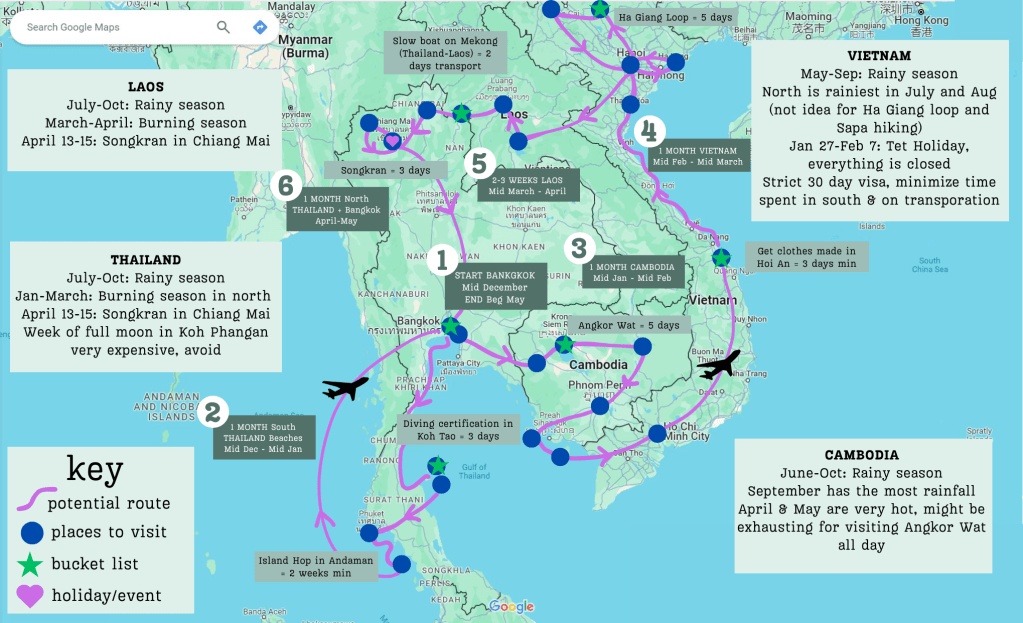
Below I’ve put an example of a 4-5 month sample route for visiting a portion of Southeast Asia. You can use the steps listed above to do something similar. With this route, I have an idea of where I want to go, when, and for how long. I’ve made sure to try and avoid the rainy season in most locations while still being able to visit Chiang Mai for Songkran celebrations and avoid Vietnam during the Tet holiday. I also make sure that I incorporated my bucket list activities and places into my route. Lastly, I made note of where I anticipate taking a flight instead of a bus or train.
A Few Tips
- Be realistic in the amount of time you plan on staying in each country / location. Nothing is worse than planning a route somewhere and overpacking the itinerary. You should take into consideration that transportation takes time, and sometimes you need a rest day or two. If you’re not careful you’ll end up spending all your time on buses and trains and burn out very quickly.
- In my opinion, it’s best to spend a minimum of 3-4 days in each spot you want to visit if it’s not close to any other destinations. Take this into account when planning a route. For example, don’t think that you can hit every major city and tourist spot in Vietnam in 30 days. It’s not realistic and you will burn out.
- Research the prices of flights to make a decision on your route. If you still have a couple different routes you’re considering and are stumped on which one to pick, consider researching flights from your home to and from these destinations. It’s possible that one of the routes has cheaper flights, which could help you in making your decision. This is mainly applicable if the routes have different starting and ending points.
- Be open to change and have some backup options. Like I said earlier, things don’t always go according to plan. Choosing a route doesn’t mean that it’s set in stone. You can change your mind and alter small or large portions of your planned journey. By mapping out a couple of different potential routes, you’ll be familiar with some alternative options and can create a backup plan if the need arises.
Conclusion
Congratulations! If you followed these steps then you should have a route that you can use to further plan your trip. Now you will have a better idea about when you need to apply for visas, what vaccinations you might need based on how long you’ll be in a certain country, where to buy flights to, and even what weather conditions to pack for!
Planning a long-term trip can be difficult. There are a lot of aspects to consider and things to research. My goal is to make the trip planning process easier and more accessible to everyone. If you found this post to be helpful, then check out my other related post to help you plan your trip!
- Planning a Long-Term Trip: Everything you Need to Know
- Researching your Travel Destination
- Budgeting for a Long-Term Trip





 Courtney Plans Travels
Leave a comment