

Mount Fuji is iconic. Sitting at 3776 meters, it’s the tallest and most sacred mountain in Japan. And whether or not you’ve visited Japan, you’ve probably heard of Mount Fuji before. For most people who do visit, it’s on the list of must see places. But maybe you want to take it a step further. Have you ever considered climbing Mount Fuji? If your answer was yes, then you’ve come to the right place. In this guide, you will find all the information you need to plan your climb up this world-famous mountain. And if your answer was no, then you should check out this post about my recent experience climbing Mount Fuji. Maybe it will convince you that you should put it on your bucket list. So without further ado, let’s get into it!
- About Mount Fuji – Basic Information
- Climbing Information
- Mountain Huts
- Getting to Mount Fuji*
- On the mountain
- Conclusion
About Mount Fuji – Basic Information
What is Mount Fuji?
In case you aren’t acquainted, Mount Fuji is an active stratovolcano located about 60 miles southwest of Tokyo in Japan. Its peak is at 3,776 meters and it is one of Japan’s three sacred mountains. It’s famous for its prominent snow capped peak which can be seen as far as 285 miles away on a clear day. Since ancient times, Mount Fuji has been the site of pilgrimages stemming from the Shinto and Buddhist religions. People marveled in awe of the mountain’s immense beauty and feared its destructive power as an active volcano. As a result, Fujisan, as the Japanese call it, has been prominently featured in Japanese culture as artists created paintings, literature, gardens, and other art forms featuring the mountain. Today there are still people who pilgrimage to the mountain and visit the shrines along the way; however, the vast majority of those who visit are tourists.
When is climbing season?
Mount Fuji is only open to climbers for a short period of the year; from early July to early September annually. For reference, the climbing season in 2024 was from July 1st to September 10th, though it changes each year depending on the conditions. It is prohibited to climb Mount Fuji outside of this window. In all other times of the year, the mountain is covered with snow, ice, and dangerously windy conditions.
How long does it take to climb Mount Fuji?
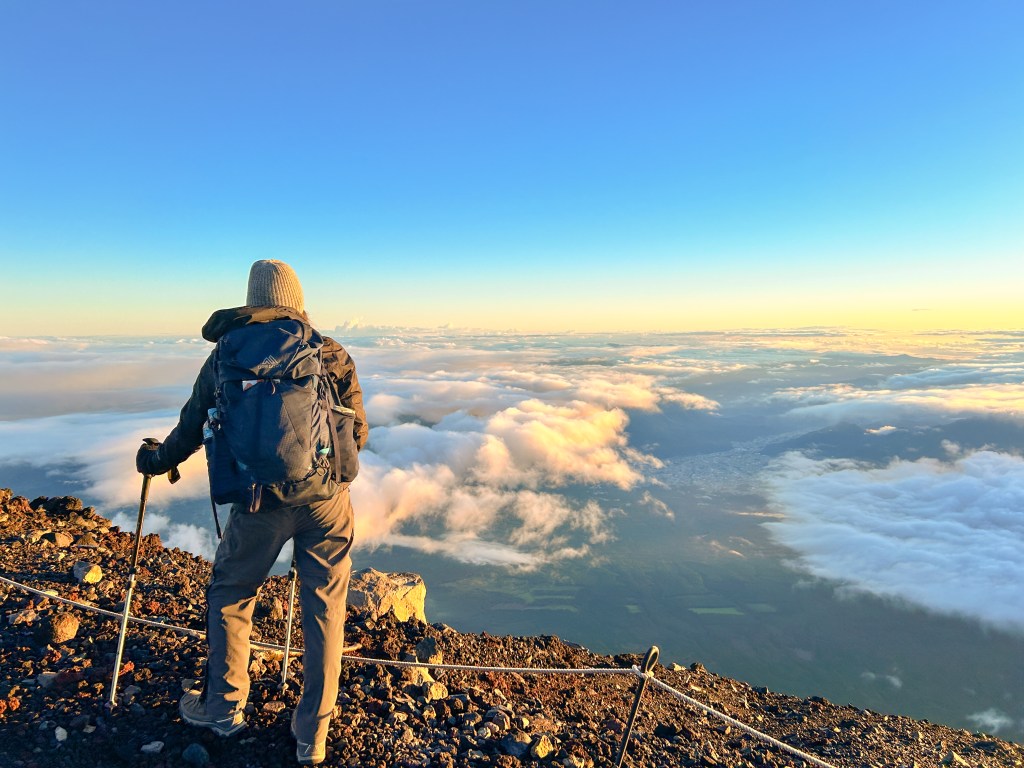
The amount of time it takes to climb the mountain depends on a number of factors including: which trail you take, how busy the trail is, your fitness level, and weather conditions. Generally speaking, the average person will take anywhere from 5-7 hours to ascend and 3-4 hours to descend but this could easily be a lot longer or shorter.
Weather on Mount Fuji
The weather on Mount Fuji is notoriously unpredictable. The temperatures can vary immensely from the base of the mountain to the summit due to the altitude. In the climbing season, the average temperature at the summit is around 41-46℉ but it can drop well below freezing when accounting for wind-chill. This temperature is vastly different from the base of the mountain where it may be hot and humid. Additionally, Mount Fuji is a standalone mountain. There are no other tall mountains near it. This means that the wind can become very strong and even dangerous. During the summer, storm clouds often develop in the afternoon and increase the risk of rain and lightning.
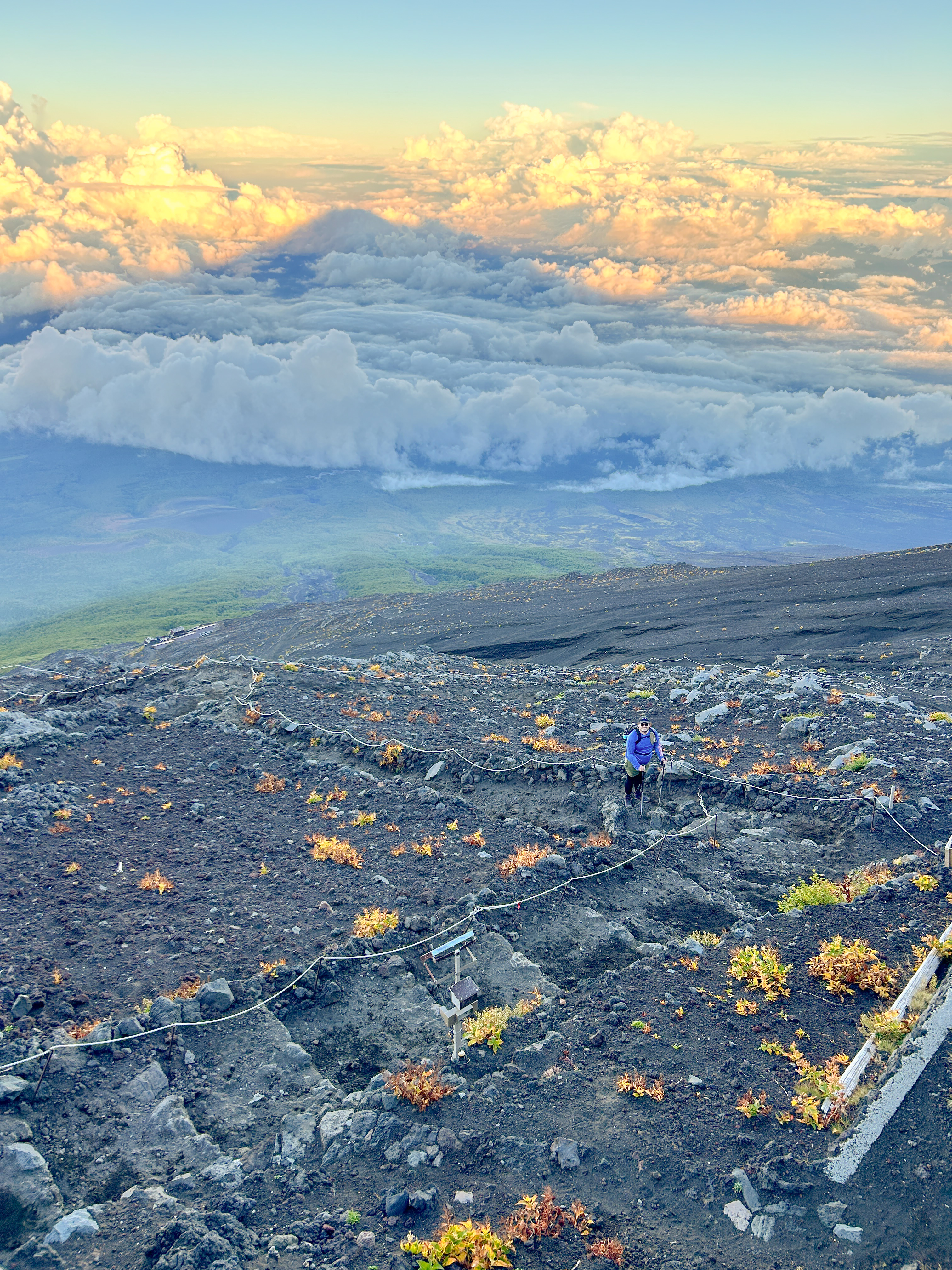
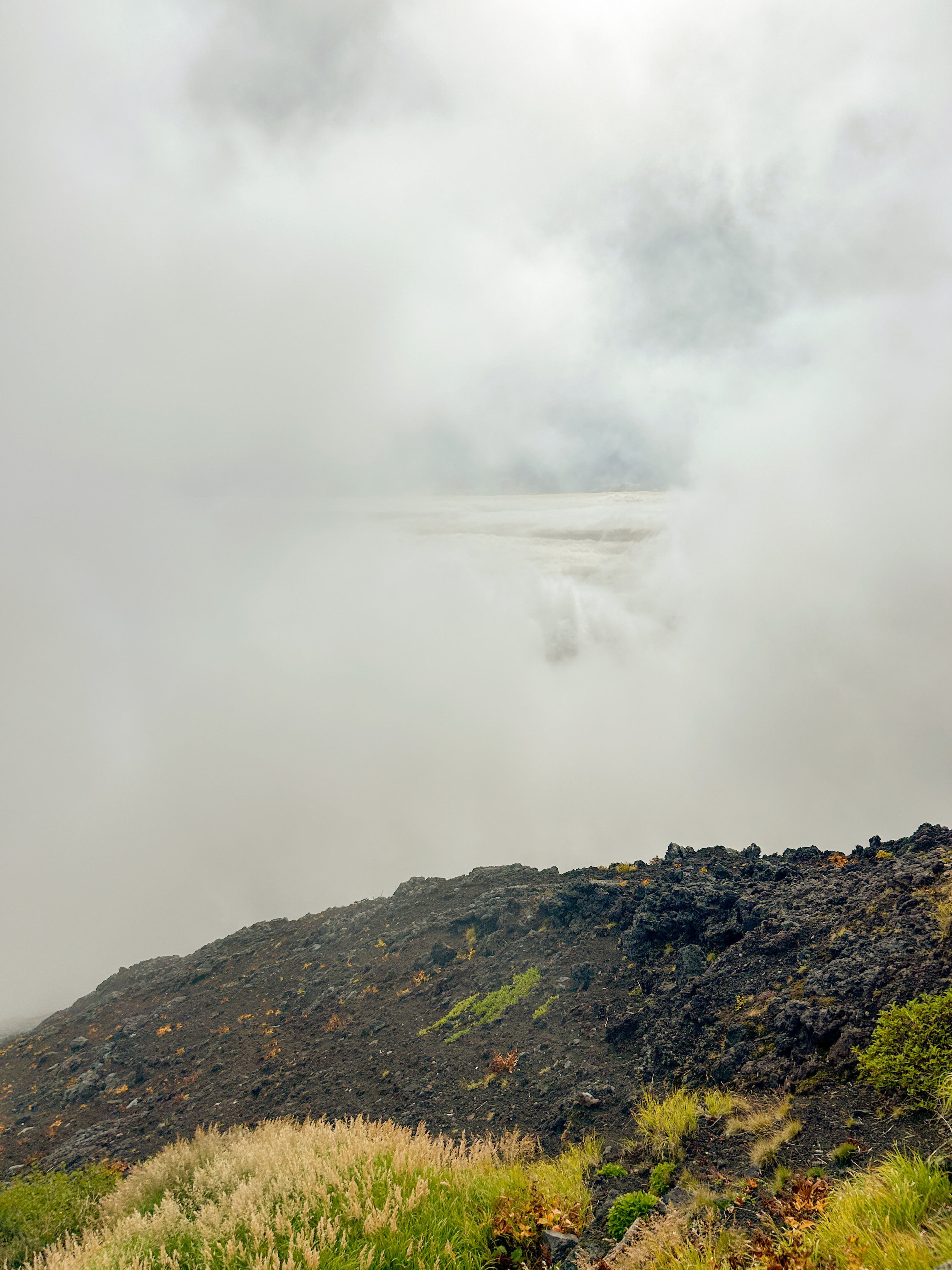
If you are climbing Mount Fuji, you need to be prepared for all types of weather conditions (hot, cold, rainy, windy, etc.). There are many websites you can use to check the weather on Mount Fuji. Japan Mountain Guides provides a weather forecast for the mountain at 3,014m and at the summit here.
Facilities on Mount Fuji
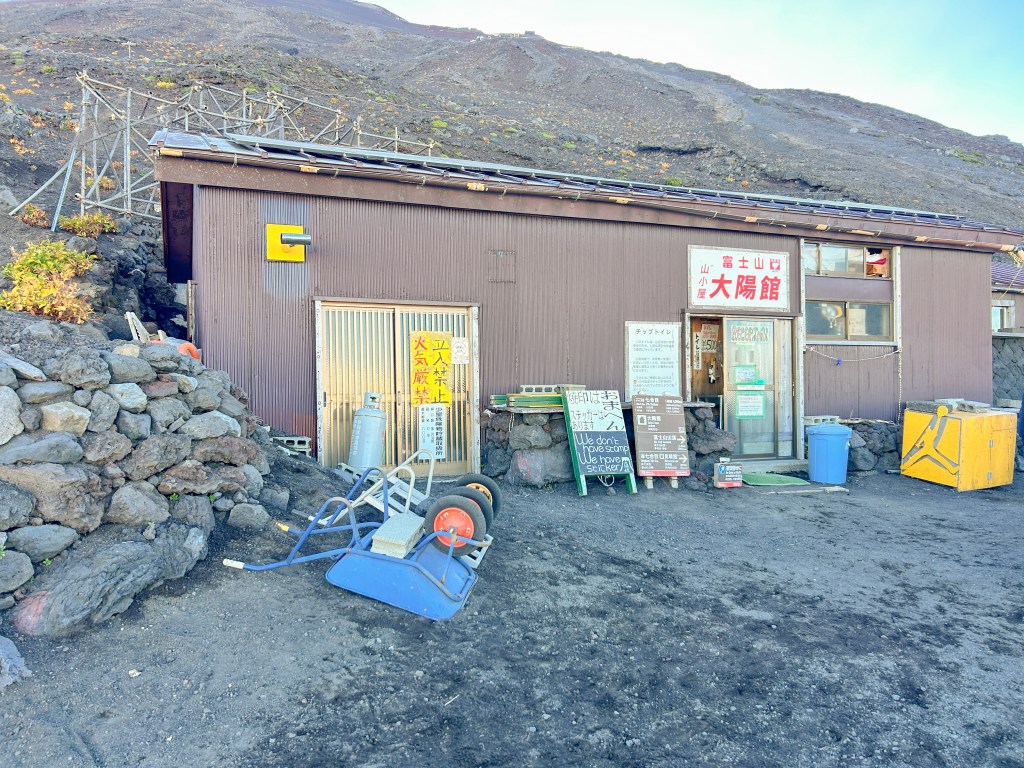
The facilities available to climbers on the mountain differs depending on the trail that you use. Generally speaking, all trails have rest stops along the way called “stations”. These stations sell souvenirs (such as walking sticks that you can get stamps burned into), hiking gear, and basic snacks, meals, and drinks. There are toilets that you pay to use and mountain huts that you can stay overnight in.
Climbing Information
Climbing Trails
There are four hiking trails you can take to reach the summit of Mount Fuji. Each trail has a corresponding color of markers on maps and along the trail. They are listed below in order of most to least popular.
- Yoshida (Yellow): This trail accounts for about 60 percent of all the climbers on Mount Fuji. It is the most popular hiking trail and has many facilities along the route. It takes about 6 hours to ascend this trail. Keep in mind when doing research that the fifth station here is called “Fuji Subaru”.
- Fujinomiya (Blue): This trail is located on the southern portion of the mountain and has the highest starting altitude. There are plenty of mountain huts and facilities available. It takes about 5 hours to ascend this trail.
- Subashiri (Red): This trail has a fair ratio of climbers to facilities. It’s not too crowded and has a couple of mountain huts to choose from. This trail meets up with the Yoshida trail at the 8th station. It takes about 6 hours to ascend this trail.
- Gotemba (Green): This is the longest of the trails and starts at the lowest altitude. It’s the least popular trail and has the fewest facilities. There are only a few mountain huts available on this trail. It takes about 7 hours to ascend this trail.
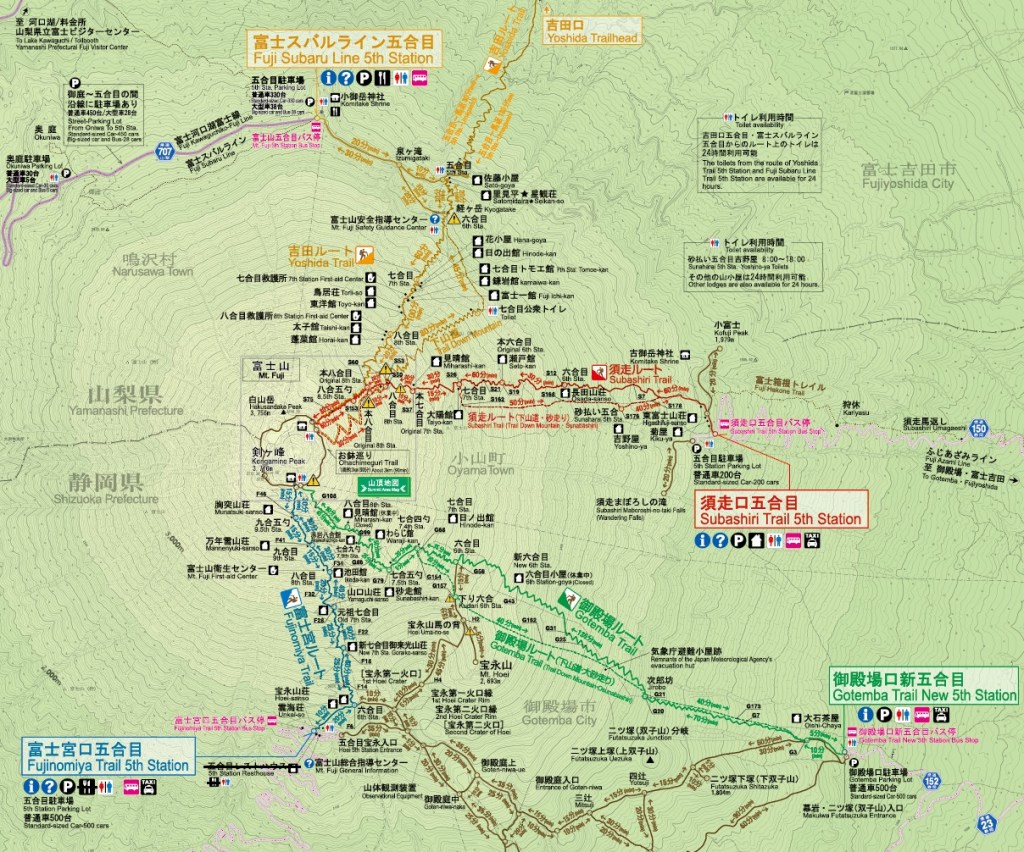
Each trail has pros and cons and features different environments and trail conditions. For further information regarding hiking trails, I recommend visiting the official Mount Fuji website here. The trail map pictured above is from their website. They have a comparison table of the trails and detailed information about each one. When I climbed Mount Fuji, I took the Subashiri trail. To read about my experience and opinion regarding this trail, check out my post here.
New government restrictions
As of the 2024 climbing season, the Japanese government imposed a series of new regulations to combat over tourism and unprepared / unsafe climbs. The regulations differ depending on which trail you use. Most of the restrictions during the 2024 season were placed on the most popular trail, the Yoshida trail. However, the government has announced that they intend to introduce similar restrictions to all trails in the 2025 season.
Yoshida Trail
- Entrance Restrictions: The trail is closed (via a gate) from 16:00 through 03:00 the next day for anyone who does not have a mountain hut reservation. Additionally there is a daily limit of 4,000 people.
- New Fees: ¥2,000 entrance fee per person, with an additional ¥1,000 voluntary conservation donation asked (expected).
Subashiri Trail, Gotemba Trail, and Fujinomiya Trail
- Entrance Restrictions: Anyone entering after 16:00 will be asked to show proof of a reservation at a mountain hut.
- Climbing Plan Registration: Climbers are required to submit a registration form with their climbing plan and contact information. This can be done online in advance, or in person via physical document.
- Conservation Donation: Climbers are asked (expected) to pay a ¥1,000 conservation donation
Mountain Huts
What are mountain huts?
Mountain huts are very basic lodging that climbers can stay overnight to rest and acclimate before reaching the summit of the mountain. These huts were originally built as emergency shelters, but now serve tourists looking to ascend the mountain. The mountain huts on Mount Fuji offer a place to sleep (in a sleeping bag), a simple meal, and a restroom. In an attempt to reduce the number of people bullet climbing, the Japanese government has imposed restrictions and encourages climbers to book a stay in a mountain hut. If you’d like to read more about mountain huts and my experience staying in one, read my post here.

Do I have to stay in a mountain hut?
The answer to this depends. You are allowed to climb Mount Fuji in one day. If you want to do this, you should start your ascent in the morning and bring adequate food, water, and gear to make it to the top and back down before nightfall. If you plan to do this, then you do not need to book a stay at a mountain hut. Keep in mind that if you’re using public transportation to get to and from the mountain from Tokyo, the times are limited. You may need to stay overnight in the area around Mount Fuji the night before you climb and take a taxi to the trailhead. This will ensure you can finish in time to make the public transportation options back to Tokyo. In my opinion, it’s better to just stay at a mountain hut at that point.

In recent years, to avoid paying for a mountain lodge many climbers have taken part in a practice called “bullet climbing”. This is when climbers start their trek in the evening or at night in order to reach the summit right before sunrise. They then watch sunrise and hike back down. Bullet climbing is unsafe and has caused a burden to Japan’s emergency services who have to make expensive and dangerous rescues. As a result, the Japanese government has taken a number of measures to prevent bullet climbing; including prohibiting anyone from entering the trails after 16:00 unless they have a mountain hut reservation.
So if you want to witness the sunrise on Mount Fuji, which I highly recommend, then you need to book a reservation at a mountain hut. Yes, it’s an additional cost, but it allows you to get some rest and acclimate to the altitude. It’s also a unique cultural experience that I think is worth the added expense. Additionally, staying overnight makes it much easier to coordinate public transport to and from the mountain. See below for more information on how to make a reservation at a mountain hut.
Booking a mountain hut
If you want to climb Mount Fuji, the very first thing you need to do (aside from research) is book a stay at a mountain hut. Do NOT show up to Mount Fuji unprepared and expecting to be able to book a reservation last minute. The climbing season is only two months long so the mountain huts sell out extremely fast.
Every year, the reservations for mountain huts go on sale around the beginning of May. In 2024, most websites opened their reservation systems on May 7th. Though there were some huts that had staggered reservations throughout the week depending on when you intended to climb. I recommend checking the websites around mid-April to see when the reservations will go on sale. Then you can be sure to be on the website right when they open.
Many of the mountain hut websites are only available in Japanese or will only accept payment with a Japanese credit card or other payment method. Some only take reservations over the phone in Japanese. If you do not speak Japanese, I recommend booking through a company called Fuji Mountain Huts (by Fuji Mountain Guides). Using their website, you can book mountain hut stays on the Yoshida and Subashiri trails entirely in English. You pay a ¥1,000 fee per person for this service. I communicated with them via email and you are able to reserve mountain huts at the same time (JST) that they open to the public on the official hut websites. I booked through this company and had no issues.
For one night on Mount Fuji at Station 7 of the Subashiri trail, I paid ¥11,660 per person (including reservations fees through Fuji Mountain Huts). With this fee, I received a spot in the sleeping quarters for the night, access to a restroom, a curry dinner, and a to-go breakfast in the morning.
Getting to Mount Fuji*
The trail that you intend to use will dictate how you get to the trailhead. For the purposes of this post, I’m going to assume you’re an international tourist and will be approaching the mountain from Tokyo.

Yoshida Trail
Express Bus: there is a direct bus service from Shinjuku station to the fifth station of the Yoshida trail. According to their website, these buses cost ¥3,800 per person each way and take approximately 2 hours and 25 minutes to reach station five. It is recommended to reserve these buses in advance.
Train + Bus: From Tokyo, you can take the train to Mt Fuji Station (Fujisan) or Kawaguchiko station on the Fujikyu Railway. First, from Tokyo, you will need to use the JR Chuo main or rapid line to get to Otsuki station. For reference, from Shinjuku station using an express train, it takes about one hour to arrive at Otsuki station. Then you will switch to the Fujikyu Railway and stop at either Mt Fuji Station (¥1,040 one way) or Kawaguchiko Station (¥1,170 one way). It takes around 45 minutes to arrive here from Otsuki station. Please note that depending on which type of train you take, there may be an additional fee. You can see the train timetable from Otsuki station here, in Japanese only. From both of these stops, there are local climbing buses that take you to the 5th station. In prior years, they have departed at least once an hour beginning at 06:20, but check this schedule closer to climbing season to see the up to date timetable. The cost is ¥2,800 roundtrip.
By Car: If you have a car, you can park at the Fujisan parking lot which costs ¥1,000 per car. There are shuttles from here to the fifth station which cost ¥2,500 roundtrip according to the website. I believe shuttles begin as early as 5:00am. Please note that this lot gets very busy and there may be long wait times for the shuttle buses. Plan to pay in cash.
Subashiri Trail
Train + Bus: From Tokyo (you can get on at Tokyo Station), you will need to get on the JR Tokaido line to Kozu Station. Then switch to the Gotemba line and get off at Gotemba station. This journey should take around two hours and cost approximately ¥1,980 one way. From Gotemba station, you will need to take a local climbing bus to the 5th station which costs ¥2,400 round trip. Here is a timetable for the bus, but it is not the official website for the bus, so it may not be completely accurate.
By Car: This is how I got to the Subashiri trailhead. If you have a car, you can park near the shuttle bus to the 5th station here, which is right by the Michinoeki Subashiri rest station. The price of the shuttle is ¥2,100 roundtrip and includes overnight parking in a gravel parking lot right next to it (don’t park in the rest station parking lot!). The shuttle leaves every hour on the hour from 05:30-18:00, according to their website. The shuttle takes about 25 minutes to reach the 5th station.
Gotemba Trail
Train + Bus: Follow the same instructions listed for the Subashiri trail above to Gotemba Station. From Gotemba station, you will need to take a local climbing bus to the 5th station which costs ¥2,000 round trip. Here is a timetable for the bus, but it is not the official website for the bus, so it may not be completely accurate. The local climbing bus departs roughly every two hours and takes about 40 minutes.
By Car: If you have a car, it seems like you can park at the Gotemba 5th Station Parking Lot No.2. It looks like there is no fee to park your car, but I can’t be sure.
Fujinomiya Trail
Express Bus + Shuttle: There is an express bus from Tokyo Station to Fujinomiya Station which takes a little over two hours. The cost is ¥2,400 per person on the weekdays and ¥2,600 per person on the weekend. Here is the timetable. From Fujinomiya station, you will need to take a local climbing bus to the 5th station. The shuttle comes approximately every two hours and costs ¥3,700 per person roundtrip. Here is a timetable for the bus, but it is not the official website for the bus, so it may not be completely accurate.
Train + Bus: It appears that from Tokyo, you need to take a Shinkansen (bullet) train from Tokyo Station to Shin Fuji station (1 hour 10 minutes). From Shin Fuji Station, you can take a local climbing bus to the 5th station. The shuttle comes approximately every two hours and costs ¥3,700 per person roundtrip. Here is a timetable for the bus, but it is not the official website for the bus, so it may not be completely accurate.
By Car: If you have a car, you can park at the Mizugatsuka Parking Lot. The parking fee is ¥1,000 per car. From here you will need to take the shuttle bus to the 5th station which costs ¥2,200 round trip and takes approximately 40 minutes.
*Note: If you are planning on climbing the mountain in one day (from early morning to late afternoon), you need to pay attention to the timetables of the public transportation. In my opinion, it’s a bit unrealistic to plan to start your day in Tokyo, take public transport to Fuji, climb up and down, and make the last bus/train back to Tokyo all in one day. I think the stress and speed of it all would ruin the experience. And in reality it may not even be possible based on the timetables of public transport. If this is your plan, the best option may be for you to stay overnight in a town near Mount Fuji and take a taxi early the next morning to the fifth station in order to finish in time to take public transportation back to Tokyo. Otherwise, just book a mountain hut and stay overnight on the mountain.
On the mountain
What to expect
Don’t go to Mount Fuji expecting to be engrossed in nature. Mount Fuji received about 203,000 climbers in the 2024 season. This averages to almost 3,000 hikers per day. To put it simply, there are a lot of other climbers. Depending on the trail you hike, you may even experience traffic jams. In addition, there are facilities along the entire climb which provide shelter and restrooms, sell food, souvenirs, and gear, and even have wifi. I had cell service the entire climb. So don’t be under the illusion that you are going to be in the remote backcountry or something. Mount Fuji is a tourist destination that has been fighting over tourism for years at the detriment of the mountain. As cool as it is to hike Mount Fuji, I wouldn’t say you feel very close to nature on your climb.

Gear and Packing List
Even though Mount Fuji is not a technical climb and can be done in about a day, you need to come prepared. You should not attempt to climb Mount Fuji without the proper clothing, gear, and supplies. Like I explained above, the weather on the mountain is unpredictable and the temperature ranges from warm to very cold depending on the elevation. You need to bring warm clothes and plan for there to be rain and wind. Here is a comprehensive list of all the things I brought on my climb:
- Hiking poles
- Gaiters
- Hiking boots
- Merino wool hiking socks
- Base layer (leggings and top)
- Midweight layer
- Coat
- Beanie (warm hat)
- Hiking pants (which zip into shorts)
- Short sleeve top
- Sports bra
- Warm gloves
- Rain gear (poncho)
- Wide brimmed sun hat
- Sunscreen
- Sunglasses
- Snacks & food
- Water – 3L
- First aid kit and blister Band-Aids
- Medications
- Power bank and charging cord
- Headlamp
- Hiking backpack and rain cover(43L, but you can definitely bring something smaller, this is just what I had to work with)
It is recommended to bring 4-5 liters of water for your climb, depending on the weather and your personal water intake. I was fine with 3 liters, while my hiking partner surpassed 5 liters. Water bottles are available for purchase at the stations along the climb, but they’re expensive. I also recommend at the very least bringing some snacks. Your mountain hut may provide a meal, and the stations do sell food, but it’s better to be prepared and have food of your own. I personally brought enough food to cover my meals without relying on any food from the huts. It’s super easy to stop at a convenience store beforehand and grab some onigiri and other food to fuel your climb!

The items that I was really glad to have brought were hiking poles, gaiters, a pair of good quality hiking socks, and a headlamp. I highly recommend bringing these items! The hiking poles make the ascent and descent so much easier. On the descent, the gaiters are especially useful for the deep volcanic sand that you’ll be climbing down in. I don’t know what I would have done without them. There would have been so much sand in my boots. A pair of good quality hiking socks will help with blisters, and keep your toes warm at the summit. And a headlamp is absolutely essential if you’ll be hiking in the dark before sunrise. I saw a couple of people using the flashlight on their phones which doesn’t shine very bright and takes away the use of one of your hands. If you don’t have these items, there are plenty of places you can rent hiking gear from in Tokyo.
Miscellaneous tips and thoughts
- Make sure that you have cash on hand for your climb. I recommend bringing more than you expect to spend, just in case. Specifically, bring a lot of coins (¥100 and ¥500 coins are perfect). The shops at the stations are cash only (except maybe at the 5th station) so if you need to purchase food or drinks, get a stamp on your walking stick, or use the restroom, you need to pay cash. Additionally, some of the shuttle buses may only accept cash payment. If you need to get coins, go to an arcade while you’re in Tokyo. They always have free change machines so you can get as much as you need.
- Be prepared, but don’t overpack. Bring the least amount that you need to safely make it up and back down the mountain. Everything you bring, you have to carry in your backpack, which can get heavy pretty quickly, especially when climbing up the thick volcanic sand.
- Take it slow and steady up the mountain. Mount Fuji is at a high enough elevation that some people can feel the effects of altitude sickness. The slower you go, the better you can acclimate and the less chance you have of feeling sick. I personally wouldn’t rely on the oxygen tanks sold at the stations to get you up the mountain. You’ll see a lot of people carrying and using them, but they’re not necessary and can actually make altitude sickness worse. You might feel better for the brief moment you’re using the oxygen, but your sickness will return shortly afterwards. If you don’t feel well, listen to your body and descend back to an altitude you can handle.
- Pack it in, pack it out. You are expected to bring all of your garbage with you back down the mountain. There are NO garbage bins at any of the stations or along the trail. Please preserve this natural wonder and do not litter. If you see trash along the trail, pick it up!
Conclusion
Climbing Mount Fuji is a challenging yet rewarding experience. If you’re in Japan and planning to travel for a view of Mount Fuji from afar, why not take the opportunity to climb it instead? The mountain offers unmatched views of the land of the rising sun, and the ability to witness a bucket list worthy sunrise. By planning your trip using the tips outlined above, you can make the most of your time on the mountain and increase your chance of having a successful climb. Please remember to respect the new rules and regulations so that we can protect Mount Fuji for future generations. Happy climbing!
If you want to read more about what it’s like to climb Mount Fuji (on the Subashiri trail) and what the experience of staying in a mountain hut is like, you can read this post:
Climbing Mount Fuji: My Experience on the Subashiri Trail.



 Courtney Plans Travels
Leave a comment