
Have you heard of sumo wrestling before? Picture this: huge, practically naked men with their hair in sleek buns, raising and slamming their legs onto the floor before pushing into each other. Does that ring a bell? Sumo wrestling is the national sport of Japan and is insanely popular. Tournaments are held throughout the year in Japan and there’s a lot more to the sport than I just described. In fact, sumo wrestling has a rich history and religious rituals that survive to this day.
I recently went to a sumo wrestling tournament in Tokyo and it was one of the highlights of my trip. If you’re considering doing the same, I highly recommend getting tickets and checking it out. In this post, I outline all the information you need to know about going to a tournament: when and how to get tickets, what happens in the matches, tips for your day at the arena, and more.
- Attending a Tournament
- Purchasing Tickets
- Additional information about the tournaments
- What is a tournament like?
- Tips and Recommendations
- Conclusion
Attending a Tournament
What is sumo wrestling?
Sumo wrestling is an ancient Japanese sport that dates back at least 1,500 years. It is a style of Japanese wrestling where wrestlers attempt to push their opponent outside of a ring, or make them fall off their feet. Sumo wrestlers are recognizable by their large size and the silk loincloths that they wear during bouts.

The origins of sumo wrestling are very religious, as is evident to this day in the rituals and ceremonies associated with the sport. Sumo was originally a Shinto ritual to pray for a bountiful harvest and to please the Shinto spirits. Over time it has evolved into the sport as we know it.
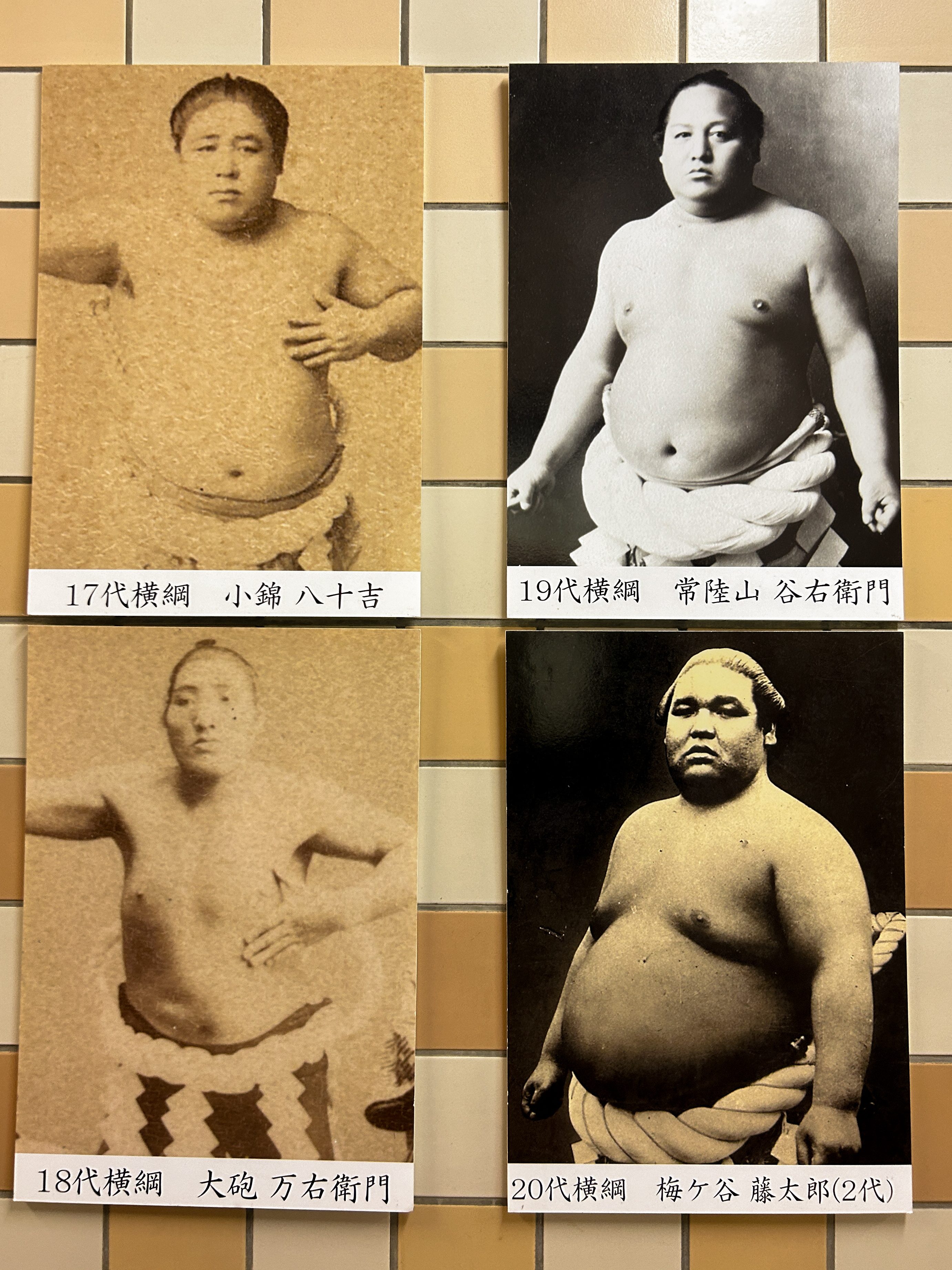
In the Edo period (1603-1868), sumo wrestling transformed into Japan’s national sport. Professional sumo wrestlers were organized to entertain society. The rules that are used today, as well as the Japan Sumo Association originated during this time period.
Today there are sumo tournaments held throughout the year in Japan. The sport still holds onto its religious roots and attending a tournament is as much a cultural experience as it is a sporting event.
Where are the tournaments held?
Sumo wrestling tournaments take place in four cities across Japan: Tokyo, Osaka, Nagoya, and Fukuoka. They are held in a large stadium with seating arranged in a rectangular shape around the ring. The stadium in Tokyo, called the Ryogoku Kokugikan (National Sumo Arena), was built specifically for the sport and the area surrounding the stadium is all centered around sumo wrestling!
- Tokyo: Ryogoku Kokugikan
- Osaka: EDION Arena
- Nagoya: Dolphins Arena (Aichi Prefectural Gymnasium)
- Fukuoka: Fukuoka Kokusai Center
When do the tournaments take place?
There are six tournaments that take place each year. The tournaments last fifteen days and always start and end on a Sunday. This means that there are always two full weekends of matches. Three of the tournaments are held in Tokyo, and one is held in each of the other cities as follows:
- Tokyo: January, May, and September
- Osaka: March
- Nagoya: July
- Fukuoka: November
You can find the official grand tournament schedule for 2024, 2025, and 2026 here. This list also gives you the date that advance tickets go on sale for each of the tournaments.
Purchasing Tickets
How to purchase tickets – Oosumo
The official website to purchase tickets online in advance is called Oosumo and it has an English version. This is the website that I used to purchase my sumo wrestling tickets for the September tournament in Tokyo, and I had no issues after the tickets were purchased.
- When do the tickets go on sale? The tickets go on sale at 10:00 am JST, approximately one month prior to the start of the tournament. I highly recommend being on the website ready to go about ten minutes prior to 10:00. The tickets sell out almost immediately in my experience, especially if you are only able to attend a couple of the dates in the tournament window. I was on the website right at ten and by the time it loaded the only seats still available were chair seats in the D section (the lowest tickets). Everything else was sold out.
- How long does it take to get tickets? You should set aside thirty minutes to an hour to try and purchase tickets. Due to the high volume of traffic, the site is VERY slow to load and often gives error messages. Don’t be surprised if you have to start over multiple times.
- What is the online process? There are five different pages you have to go through in order to have your tickets secured (ex:// ticket selection, personal details, payment & delivery, order confirmation, order). In my experience, I encountered errors that froze the page or sent me back to the beginning on every single page. At one point I was on the very last page where I had already given my payment information and was just agreeing to the terms and confirming my purchase. When I hit “submit” I was given an error and had to start all over. Just a forewarning. Once you make it through the final page, you will have an order confirmation and you will get an email with a ticket number. Then you can relax because you’ve secured your tickets.
- Where do I pick up the tickets? While the tickets are purchased online in advance, you have to pick them up at a 7-ELEVEN in person. All you have to do is go to the cash register and show the cashier your confirmation email from Oosumo. There is a message in Japanese that instructs the cashier that you are here to pick up tickets. All they need is the 13 digit ticket number from the email. They will print them out and then you’re good to go!
How much do tickets cost?
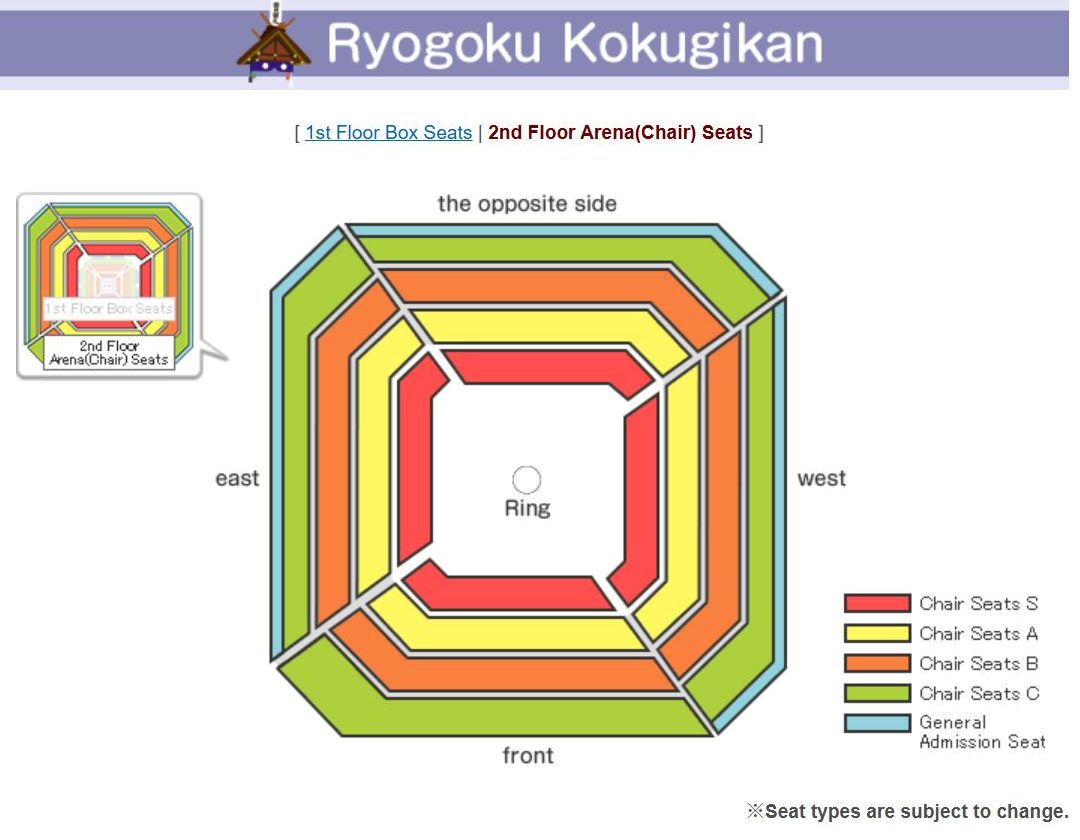
The price of the tickets depends on the location of the seats and the day of the week. Tickets on the weekend and holidays are slightly more expensive than those during the week. The seats can be broken up into three main sections. The prices listed below are the prices from the official oosumo website for a tournament in Tokyo.
Ringside Seats: These are the most expensive and difficult seats to get. Ringside seats are sold individually and have the best view in the stadium. You do run the risk of a wrestler falling out of the ring and onto these seats (you). Ringside seats cost ¥20,000 per person.
Box Seats: Box seats are located on the ground floor of the stadium. They are sold in groups of four seats. You must purchase the entire box, even if you don’t want all four seats. These seats are on the floor and you get four cushions to sit on. There are little railings that separate all of the boxes. I’ve read that these seats may be uncomfortable for those who need back support and if you have tall people in front of you it can be difficult to see.
- Box seats are further categorized by distance from the ring – S, A, B, and C. The closest seats being ‘S’.
- Box seats range from ¥60,000 on the high end to ¥38,000 on the low end for the entire box.
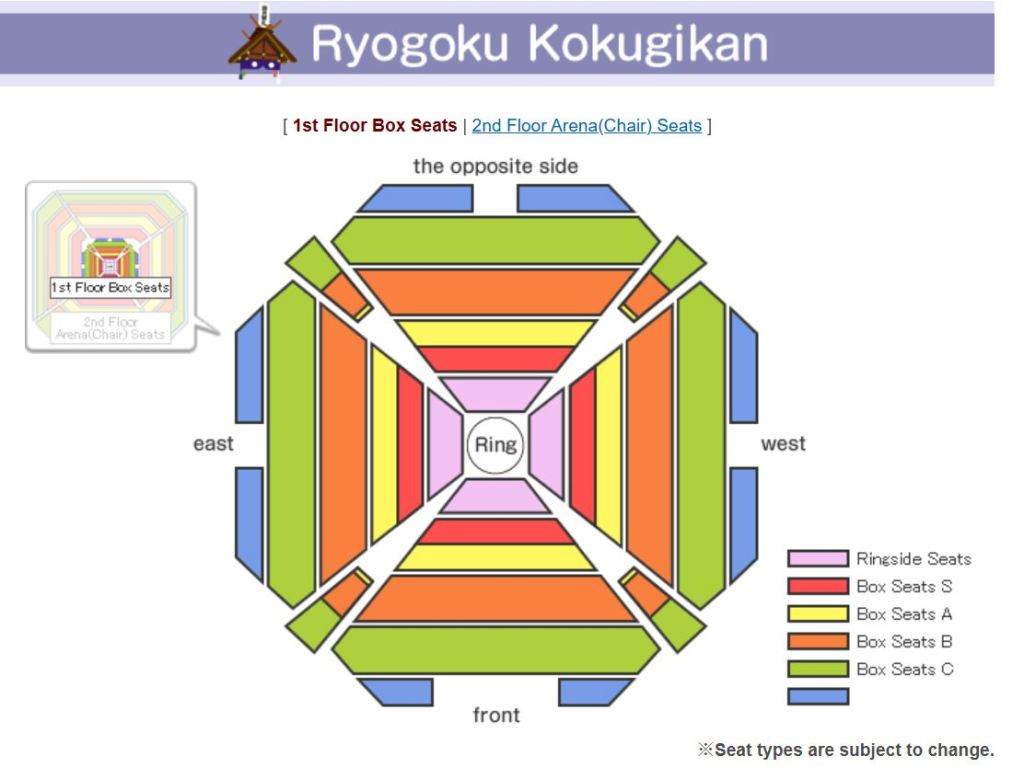
Chair Seats: Chair seats are located on the upper floor of the stadium. These are the most affordable types of tickets and can be bought individually. These are cushioned seats with a backrest. They are the farthest tickets from the ring, but offer an elevated view of the matches.
- Chair seats are further categorized by distance from the ring: S, A, B, C, and D. The closest seats being ‘S’.
- Chair seats range from ¥9,500 on the high end to ¥2,500 on the low end.
What if the official website doesn’t work?
I’ve read a lot of information online from people who tried to use the website and were unable to secure tickets due to issues on the oosumo website. Here are some other options:
- BuySumoTickets.com – This website allows you to purchase ‘presale’ tickets (prior to when they officially go on sale). When purchasing, you have to choose one date and two alternate dates if available. You are not guaranteed to get tickets, but they try their best to get them for you. They deliver the tickets to your hotel. You do have to pay a markup, but you may be more likely to get tickets and won’t have to test your luck on the website. I have not used this website, so I can’t personally vouch for it. But based on my research it seems reliable. Please note that, according to the website, you have to place your order at least five days before tickets go on sale nationwide.
- What is the markup? The markup doesn’t seem to be consistent. However, here are some price comparisons I did for an upcoming tournament (compared to the prices on the official website).
- B Box (4 seats) on a weekday: ¥7,600 markup
- C Chair Seat (1 seat): ¥1,800 markup for a weekday, ¥3,600 markup for weekend and holidays
- What is the markup? The markup doesn’t seem to be consistent. However, here are some price comparisons I did for an upcoming tournament (compared to the prices on the official website).
- Purchase tickets from a third party (Get Your Guide, Klook, Viator, etc.) – If you purchase tickets through this option, you must go on an organized tour. Prices vary depending on what kind of seats you want. But for a quick comparison, one ‘C’ chair seat costs around $100 USD via a third party source (they cost ¥3,500 or about $22 USD on the official website). These options usually include some sort of audio tour or guide and are on a specific timeline. This means you won’t be able to arrive early for the less advanced matches.
What does a ticket include?
All tickets are valid for the entire day from about 08:00 to 18:00. You are allowed to leave and re-enter once per ticket, and you must re-enter by 17:00. If you wish to do so, just inform a member of staff (at the South Gate in the Tokyo Ryogoko Kokugikan) who will stamp your hand with a stamp that can be seen under a black light.
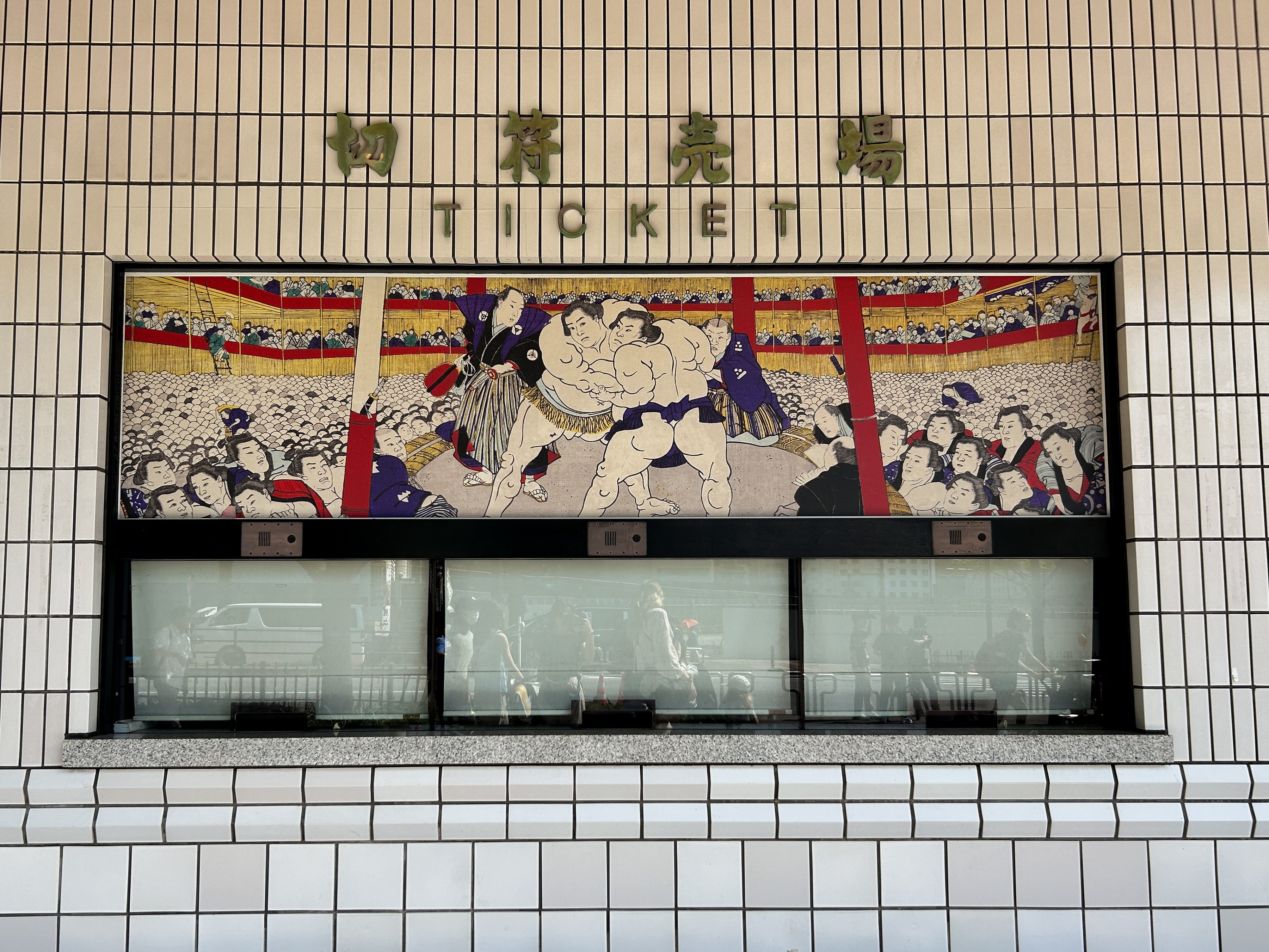
Your ticket will have an assigned seat that you are expected to sit in. However, you can arrive earlier in the day when the stadium is pretty empty and sit in unoccupied seats until it starts to get busier.
I’ve read that you can even go to the lower level seats (the boxes) to get photos in the morning session. However, I didn’t do this myself so I can’t vouch for it. I would say it’s worth a shot if you’re there. The worst that can happen is a worker tells you ‘no’ or asks you to leave.
Additional information about the tournaments
Schedule of Bouts
Each day of the sumo tournament is essentially split up into three sets of matches. In the early morning there are preliminary bouts between wrestlers of lower divisions. There are very few people in the crowd during this time and the wrestlers are less experienced. In the early afternoon there are bouts between the second highest division of wrestlers, the jūryō. And lastly, in the late afternoon and evening there are bouts between the highest division of sumo wrestlers, the makuuchi. These are the most intense and high energy matches of the day.
When you arrive at the stadium, you can pick up a sheet that gives you a timetable for the day, a map of the arena, and a list of all the wrestlers and matches for the day. Here is a sample schedule based on the day that I went to the tournament.
- 09:30 – Preliminary bouts
- 14:15 – Jūryō entrance
- 14:35 – Jūryō bouts
- 15:40 – Makuuchi entrance
- 16:05 – Makuuchi bouts
- 17:30 – Expect matches between the top ranked wrestlers
- 18:00 – Bow twirling ceremony
What is the difference between some of the top ranks and titles of sumo wrestlers?
The sport of sumo wrestling is split up into six divisions by rank. There are approximately 650 professional sumo wrestlers, also called rikishi, in these divisions. Here are the main matches you will see at a tournament:
- Jūryō: This division consists of only 28 wrestlers. It is the second highest division of wrestlers. These wrestlers will compete in all fifteen days of the tournament. They are high level competitors and are paid a regular monthly salary.
- Makuuchi: This is the highest division of the professional sport and includes the top 42 wrestlers in sumo. They are paid a high monthly salary and gain a significant amount of media attention. The division is ranked from best to worst, the best being the Yokozuna. Before every tournament, the wrestlers are considered for promotion or demotion.
- Yokozuna (Grand Champion): The highest achievement in sumo wrestling. In order to receive this title, you must win two major tournaments in a row while at the rank of ozeki, the rank which is directly below Yokozuna. There have only been 73 yokozuna since formal record keeping started in 1789. There is only one current yokozuna named Haruo Terenofuji. He is from Mongolia and has been a yokozuna since September 2021.
What is a tournament like?
I got tickets to day 10 of the September tournament in Tokyo. I arrived at the stadium at around 13:00, having had lunch prior to arriving. I was excited about seeing the bouts, but I didn’t have really high expectations. I had a feeling that the first couple of matches would be exciting, but after that it might start to be a bit less thrilling. This expectation was the complete opposite of my experience. I thoroughly enjoyed the entire day of bouts, which only got more exciting as the day went on.
Ryogoku Area
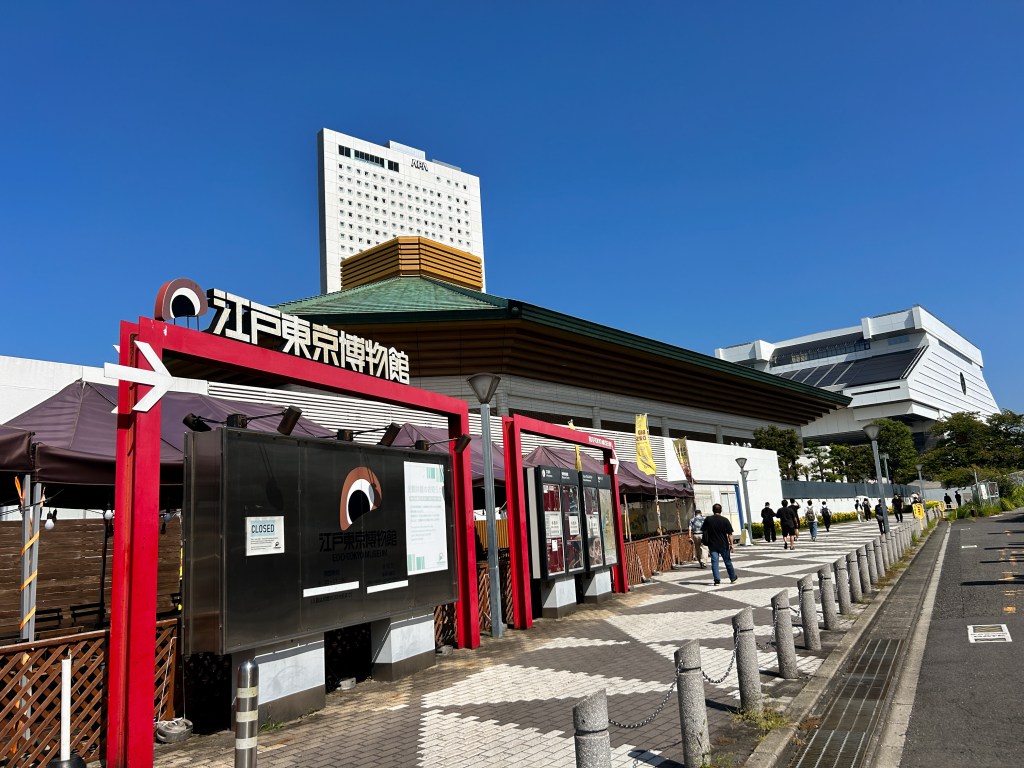
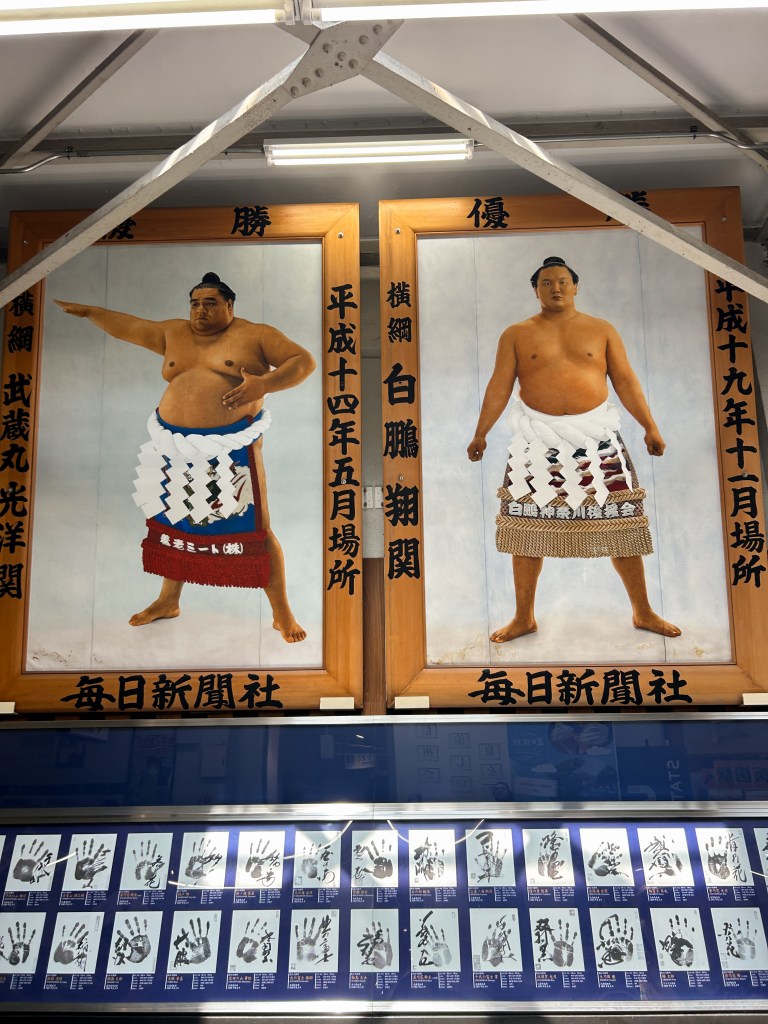
Before entering the stadium, I took a little time to explore the surrounding area and I would recommend you do the same. Everything in the Ryogoku area reflects the sport. The train station has large paintings of the wrestlers and handprints of their giant hands at the entrance. Right next to the train station is the tourist information center. Inside this building is a “street” in the Edo period style. There are free restrooms, restaurants, and little stands selling art and sumo related items. But most importantly, there is a full sized sumo ring. Take a look at this and it will really put into perspective the matches that you’ll see during the tournament.
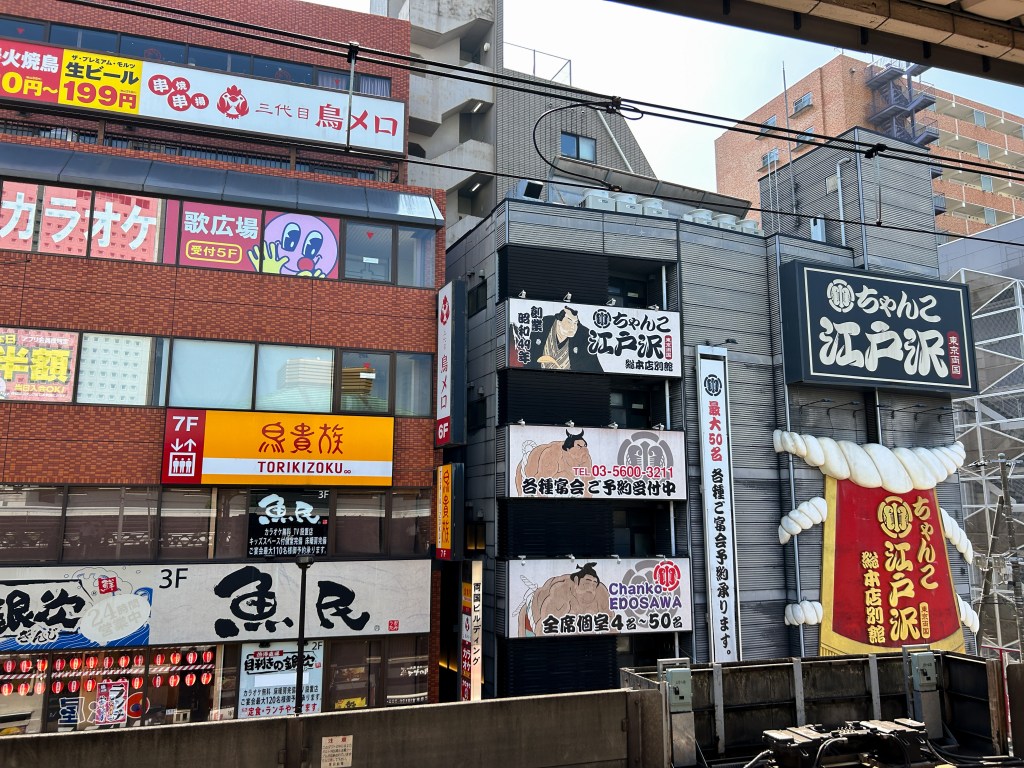

If you want to purchase some snacks for the stadium, there is a 7-ELEVEN directly outside of the west exit of the train station on the right. You can’t miss it. However, on tournament days, it’s packed. Instead, I recommend taking a left out of the train station exit and another left down Ryogoku Station Way. There is a Family Mart with a pretty good selection just a minute’s walk away. For more info on food and drinks, see my tips and recommendations below.
Stadium
After stocking up on snacks, I made my way into the stadium through the entrance hall near the south gate. Make sure to grab a sheet with a map of the arena and a tournament schedule once you arrive.
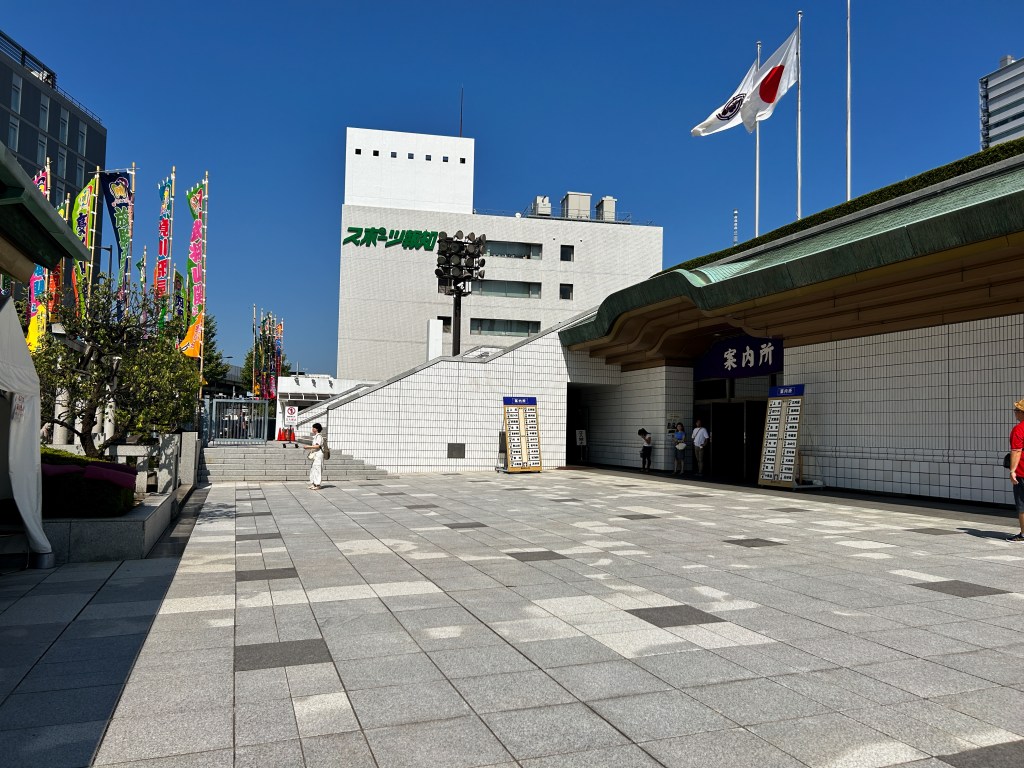
In the entrance hall, on the right hand side there is a free sumo museum that is open from 12:30-16:00. If you go straight from the entrance, you will see a display with trophies from previous tournaments.

Both the lower and upper levels of the stadium have a variety of souvenir shops, concession stands, and even capsule toy machines. The concession stands sell many different kinds of foods and sumo themed bento boxes.
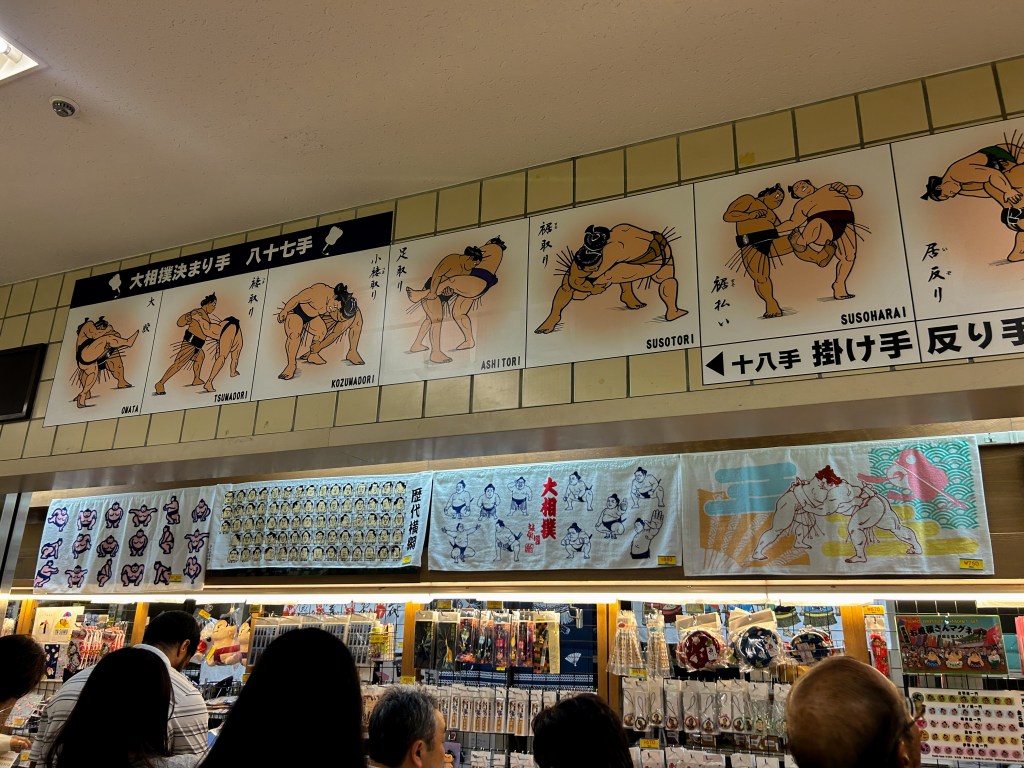
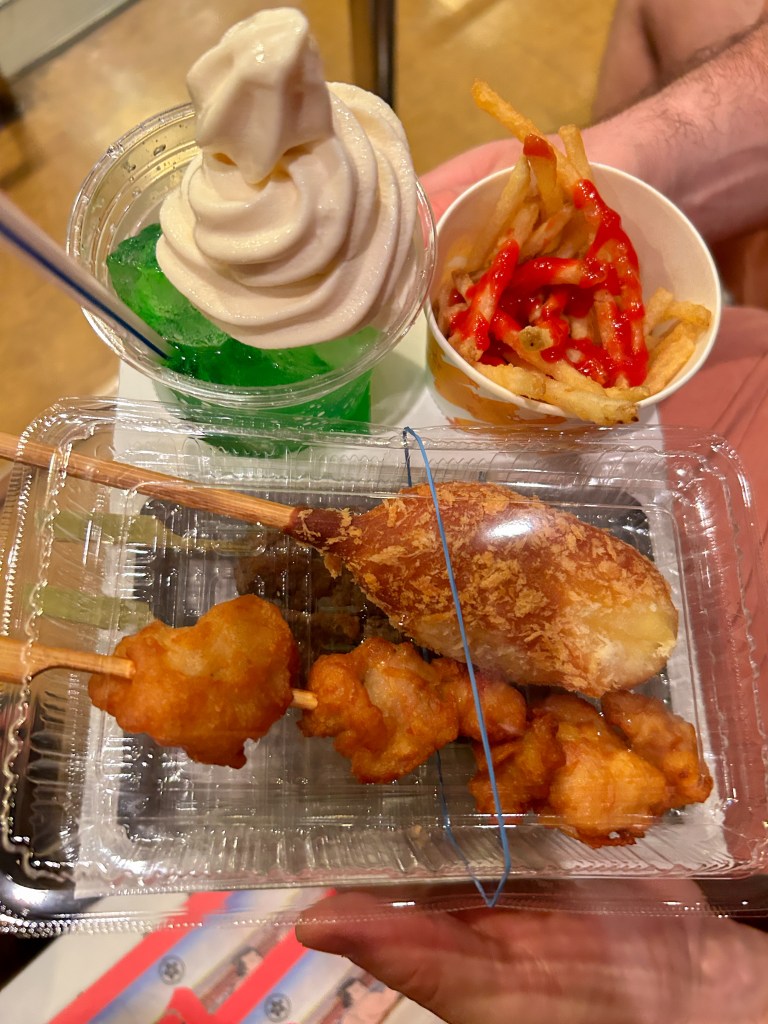
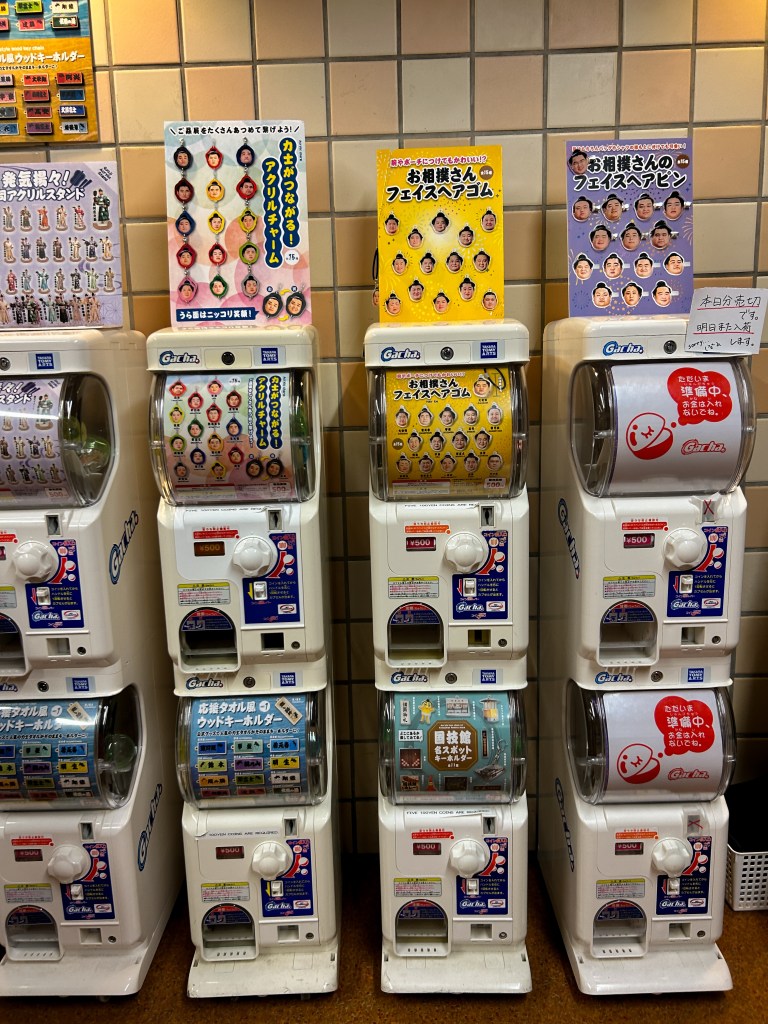
Depending on what time you arrive, you may or may not be able to go to the lower sections to take some photos of the lower division bouts up close. When I arrived, there were workers on the lower levels checking your ticket to make sure it matched the area. I believe that in the morning you can try to enter this area, even with an upper level ticket, but I didn’t try.
Seats
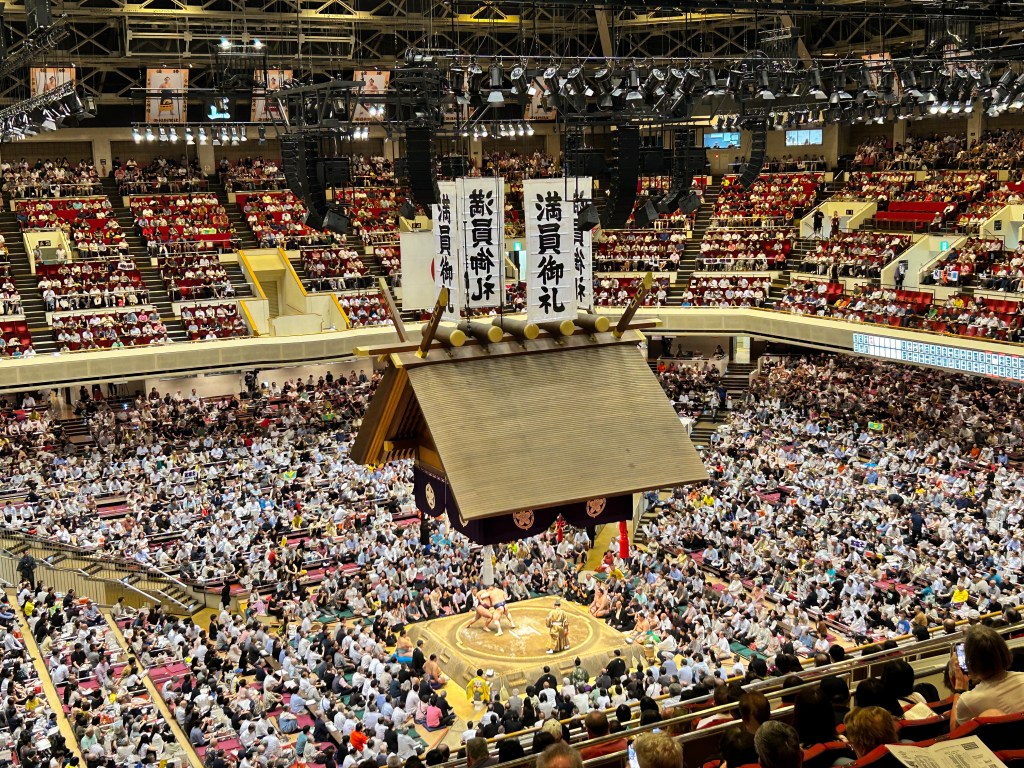
My tickets were in the upper level of the stadium at the very back. When I arrived at around 13:00 there weren’t many people in the area. Most of the seats were empty. So instead of sitting in my assigned seat, I walked down a ways and chose a different seat with a better view near the edge. I stayed here and took some pictures until it started to get busy, then made my way back to my seat. I will say, even for the seats in the very last row, you have a pretty good view of the action below.
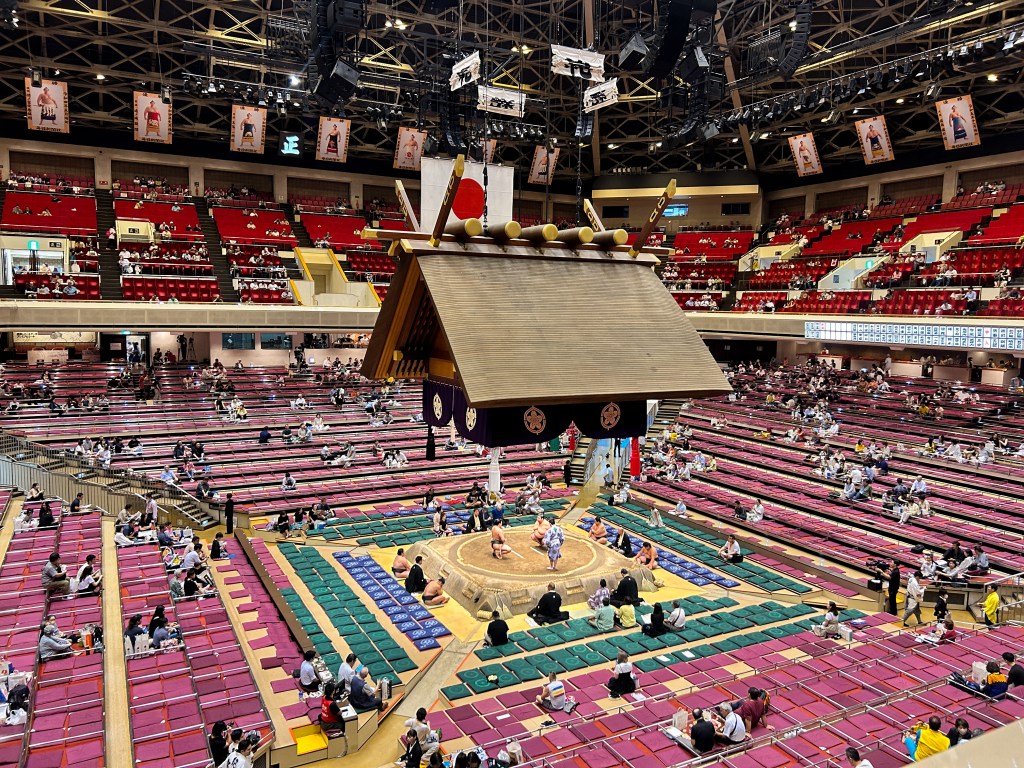
I was really amazed by the setup of the stadium. The ring where the wrestlers fight is in the center of the arena. Hanging above it is a sort of roof that looks like it belongs to a shrine. It has four large tassels hanging from each of the corners to signify the four seasons.
The ring itself is made out of clay and covered with a thin layer of sand. The ring is in the shape of a square, and then has a white inner circle about 15 feet in diameter where the wrestlers fight. It’s quite interesting to watch in between matches when they sweep the sand and use a watering can on it (I’m not sure if this is a ritual or for practical reasons).
Basic rules of sumo wrestling
The rules for sumo wrestling are pretty simple. The goal is to force your opponent outside of the ring or to make him touch the ground with any body part other than the soles of his feet. If you achieve this, you win.
It is against the rules to pull hair, gouge eyes, choke, strike with fists, grab the crotch area, or kick your opponent in the chest or stomach. Pretty much anything else is fair game
Rituals
While it is true that there is a lot of down time between bouts and in the lead up to bouts, it’s a pretty unique cultural experience.
When the wrestlers step into the ring, they perform their first ritual. This is the one you are probably the most familiar with. They raise their legs up to the side and stomp them back down. They also raise their arms and clap their hands.
After this, the wrestlers leave the ring and do a couple of cleansing rituals. First they receive something called “strength water” that they rinse their mouth with. They then take a towel and wipe themselves off. After this, they take a handful of salt and throw it into the ring before they enter.
While watching the bouts it seemed like some of these rituals were repeated over and over again. However, we noticed that once they wiped themselves with the towel, it was game time. I only saw them do this once per match and very shortly afterwards, the bout would begin. So if you’re watching, once you see the towel, it’s time to pay attention!
Bouts
I was surprised to learn that there is no official start time or whistle of sorts that tells the wrestlers when to begin. Instead, the wrestlers themselves decide when the bout begins.
The referee has to give the signal for the bout to begin. Then both wrestlers stand crouched behind the white lines in the center area of the ring on their respective sides. Whenever both of the wrestlers have clenched fists resting either on or behind their white line, the bout begins. And once it begins, the winner is decided very quickly!

It was so thrilling to see the force of the two opponents smashing against each other. Some of the matches were decided right in that first clash. In other matches, the wrestlers would almost dance on the edge of the ring, teetering and doing everything they could to avoid falling. Sometimes the wrestlers would be in a deadlock using all of their strength until someone was able to make a swift move to end the match. In some cases, the wrestlers go flying off of the elevated ring and into the spectators in the ringside seats! It really is worth all of the rather slow lead up to the bout.
Ceremonies
Besides the rituals that all of the wrestlers partake in before their bouts, there are a couple of ceremonies throughout the day. Before the Jūryō and Makkuchi bouts begin, there is an entrance ceremony for each. All of the wrestlers come in dressed in ceremonial apron belts. These aprons are made of silk and have elaborate designs on the front. The aprons are very high quality and can cost upwards of ¥1 million yen. The wrestlers stand in a circle, in order of rank and do a ritual.
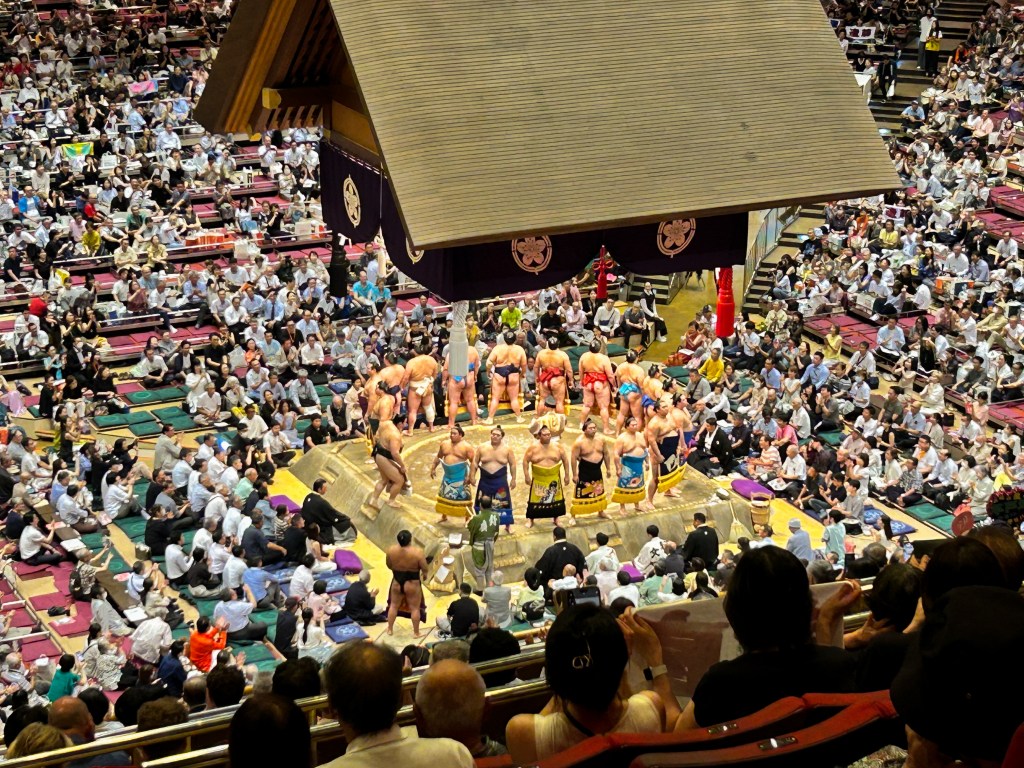
At the end of the day, after all of the bouts have finished, there is a bow twirling ceremony. One of the sumo wrestlers enters the ring and is handed a traditional bamboo bow (as in a weapon). The bow doesn’t have the string on it. Then the wrestler will move or twirl the bow in a specific order. After this, the tournament day is officially over.
Tips and Recommendations
- Arrive early! If you have time, I recommend dedicating the day to sumo wrestling. Show up in the morning so that you can try and spend some time in the lower sections. Here you can get some great pictures and see the action of less advanced wrestlers up close. I wish I would have done this. You can leave the arena around lunch time. Go to a restaurant for lunch and check out the other cool sumo related things in the area. Then return in the afternoon for the more intense matches and some of the ceremonies.
- Bring snacks! While there are some sumo themed bento boxes you can purchase at the arena, I recommend eating lunch somewhere outside of the arena and bringing some small snacks in your backpack or purse. This is especially true if you have any dietary restrictions. As another note, I didn’t see any vegan food options at the arena. The signs outside the arena said no food and drinks, but there was nobody enforcing this and I brought in lots of snacks. Worse case scenario if they stop you, you can walk back to the train station and use a coin locker to store the snacks until after the tournament ends.
- Consider bringing a pair of binoculars. This is not necessary, but if your seats are really high up, it might be nice to have a pair of binoculars to see the matches up close. I found that all the seats had good views, even those very high up. But there are no screens, like in other sports stadiums, that show the match live. So whatever your view is from your seat is what you’ll be able to see.
- Pay attention to the seats! All of the tickets in the arena are valid for the entire day. So if you see a large group of people show up and then leave (and it seems permanent) then you can go ahead and take their seats. Just know that if they return you should move back to your assigned seat. I arrived pretty early to the arena and there was a large group of Australian high schoolers on a field trip quite a few rows below us. I noticed that they ended up leaving for good, so I actually sat in their seats for the remainder of the day. They had a better view than my original seats.
Conclusion
Overall, I was really impressed with my experience at a sumo tournament. It’s pretty amazing that the sport is able to stay so in tune with its origins and all of the rituals and ceremonies at its core. I think that sumo wrestling offers spectators the perfect mixture of high-energy entertainment and meaningful cultural traditions. While it can be difficult to obtain tickets, I highly recommend attending a sumo wrestling match if you are in Japan when a tournament is happening!




 Courtney Plans Travels
Leave a comment